Today's
EarthStation1.com 15% Off Commemorative Memorial Title: WJSV Radio
Entire Broadcast Day 9/21/1939 MP3 CD, Download, USB Drive
Today, January 27, 2026
January 27: National Chocolate Cake Day:
-- An annual celebration fo the world's favorite cake! More often
than not, we celebrate our special occasions like anniversaries,
birthdays and weddings with cake. Why not enjoy chocolate cake on
January 27th every year? In America, chocolate was consumed
primarily as a beverage until the 1830s or 40s. Chocolate cakes,
as we think of them today, mostly did not exist then. According to
the Dover Post, the chocolate cake was born in 1765 when a doctor
and a chocolate maker teamed up in an old mill. They ground up
cocoa beans between huge millstones to make a thick syrup. The
liquid was poured into molds shaped like cakes, which were meant
to be transformed into a beverage. A popular Philadelphia cookbook
author, Eliza Leslie, published the earliest chocolate cake recipe
in 1847 in The Lady's Receipt Book. Unlike chocolate cakes we know
today, this recipe used chopped chocolate. Other cooks of the time
such as Sarah Tyson Rorer and Maria Parloa all made contributions
to the development of the chocolate cake and were prolific authors
of cookbooks. The first boxed cake mix was created by a company
called O. Duff and Sons in the late 1920s. Betty Crocker released
their first dry cake mixes in 1947. When it comes to food
holidays, we know how to celebrate. This one is no different. Have
some cake! Share it with someone else. Visit your favorite bakery
and give them some credit, too. Or, if you have some mean baking
skills, show them off! We want to see them, too. That means, share
your recipes, take some pictures, make a video and show off those
delicious, chocolatey cakes! We love how you celebrate these days,
so celebrate them with us! And use #ChocolateCakeDay to post on
social media. On Sale @ 15% Off Discount Till Midnight PT!
https://store.earthstation1.com/wjsv-radio-mp3-cd-entire-broadcast-day-sep-3211939.html
Today's
EarthStation1.com 15% Off Commemorative Memorial Title: Jack Paar
Late-Night TV Talk Shows DVD, MP4 Download, USB Flash Drive
Today, January 27, 2026
January 27: Thomas Crapper Day: -- The
death anniversary of the famous English businessman and plumber.
While Thomas Crapper was not the inventor of the toilet (a common
misconception), he did perfect and promote it. While the original
flush toilet was functional, Crapper added a dash of elegance to
the design. His designs even saved water by adding the ballcock
that stops water flowing into the toilet when the tank is full.
Thomas Crapper Day is a day of celebration for this man and all he
did to bring a revolutionary change in the toilet world. Since the
beginning of human existence, there has been human excretion. For
many years, and even today in certain developing countries, humans
were compelled to excrete openly. This was unhygienic and
dangerous as it led to many fecal-oral and waterborne diseases.
Very early on, people recognized the need for proper sanitation.
Around fourth century B.C., sewers and toilets were invented in
Mesopotamia. The Indus Valley Civilization housed the first urban
sanitation system, and Mohenjodaro built toilets into the walls of
houses. The Roman Civilization used latrines and the Greeks
started to use chamber pots. These early toilets often employed
some sort of flushing or flowing water mechanism, however, there
were also many versions of dry toilets. In modern history, chamber
pots, cesspits, and cesspools were used for a long time. It wasn't
until the 19th century that health experts emphasized sanitation
and pushed for the development of an underground network of pipes
to carry away solid and liquid waste. Known as the water closet
back then, this new toilet system didn't become widely used until
the late 19th century. Toilets had been invented, but the
emergence of Thomas Crapper in the toilet world sped things up. In
the 1880s, he set up The Crapper & Co. showroom in London. He
patented and manufactured sanitary appliances such as pipe joints,
drain improvements, manhole covers, and water closet improvements
like the floating ballcock. Thomas Crapper did not invent the
first water closet, but he perfected and promoted it immensely.
Through his bathroom fixture showrooms, he popularized flush
toilets like no other. Fast forward to today, water closets are
widespread in different parts of the world, and Thomas Crapper
played a role in making toilets the way we know them today. On
Sale @ 15% Off Discount Till Midnight PT!
https://store.earthstation1.com/jack-paar-tv-shows-old-time-television-dual-layer-dvd.html
Today's
EarthStation1.com 15% Off Commemorative Memorial Title: Search For
Battleship Bismarck w/ Robert Ballard DVD, MP4, USB Drive
Today, January 27, 2026
January 27: National Geographic Day: -- A
day to pay homage to the "National Geographic Magazine"
that has been up and running for over 100 years. Covering a wide
array of topics from science, geography, history, and world
culture, National Geographic has endlessly catered to every
audience member and deserves a day to be recognized for the
massive role it plays in our society. The National Geographic
Society, an organization for increasing and diffusing geographic
knowledge, was founded in 1888. The society set up its official
monthly magazine called the "National Geographic Magazine"
(a.k.a. "Nat Geo") in the same year. The magazine was
intended to bring natural, historical, anthropological, and lots
more other information to its U.S. audience. However, its
popularity was such that it wasn't long before it made its way
across the globe. For over 100 years, the "National
Geographic Magazine" has brought information to children,
adults, educators, history buffs, geography geeks, armchair
travelers, and basically anyone with any interest - "Nat Geo"
has something for everyone. Over the years, "National
Geographic" has made a name for itself and established itself
as a credible source of information. Funded by a non-profit
organization with the sole purpose of educating, an incredible
team backs "Nat Geo," which has led to its long-running
success. What started as a scholarly journal now has over 40
million current readers. Another thing that has kept "National
Geographic" relevant is its effort to evolve with the times.
While the objective and foundation of the publication have
remained the same, "National Geographic" has evolved
with the digital age and introduced various types of online
sources as well. From a website and newsletters to captivating
documentaries, "Nat Geo" reaches audience members and
educates even those who may not be avid readers. "National
Geographic" is undeniably a one-of-a-kind educational source
and deserves to be recognized for all it stands for. National
Geographic Day is a chance for us to celebrate one of the most
widely read magazines of all time. On Sale @ 15% Off Discount Till
Midnight PT!
https://store.earthstation1.com/search-for-battleship-bismarck-robert-ballard-dvd-mp4-usb-driv4.html
Today's
EarthStation1.com 15% Off Commemorative Memorial Title: Vietnam:
The Ten Thousand Day War TV Series DVD, Video Download, USB
Today, January 27, 2026
January 27: Vietnam Peace Day: -- January
27, 1973: The Aftermath Of World War II: The Cold War: The Cold
War In Asia: The Indochina Wars: The Vietnam War (The Second
Indochina War, The Vietnam Conflict, The Resistance War Against
America): -- The Vietnam War: U.S. involvement in the Vietnam War
ends as North Vietnamese and American representatives signed an
agreement in Paris. The U.S. agreed to remove all remaining troops
within 60 days thus ending the longest war in American history up
to that point (the longest war in American history is currently
The Afghan War). Over 58,000 Americans had been killed, 300,000
wounded, and 2,500 declared missing. A total of 566 prisoners of
war had been held by the North Vietnamese during the war, with 55
reported deaths. The Vietnam War (Vietnamese: Chien tranh Viet
Nam), also known as the Second Indochina War, and in Vietnam as
the Resistance War Against America (Vietnamese: Khang chien chong
My) or simply the American War, was a conflict in Vietnam, Laos,
and Cambodia from November 1, 1955 to the fall of Saigon on April
30, 1975. It was the second of the Indochina Wars and was
officially fought between North Vietnam and South Vietnam. North
Vietnam was supported by the Soviet Union, China, and other
communist allies; South Vietnam was supported by the United
States, South Korea, the Philippines, Australia, Thailand, and
other anti-communist allies. The war, considered a Cold War-era
proxy war by some, lasted 19 years, with direct U.S. involvement
ending in 1973, and included the Laotian Civil War and the
Cambodian Civil War, which ended with all three countries becoming
communist in 1975. On Sale @ 15% Off Discount Till Midnight PT!
https://store.earthstation1.com/vietnam-the-10000-day-war-4-dual-layer-dvds-all-13-10000413.html
Today's
EarthStation1.com 15% Off Commemorative Memorial Title: Auschwitz
And The Allies 2 Part TV Series DVD, Download, USB Drive
Today, January 27, 2026
January 27: International Holocaust
Remembrance Day: -- An international memorial day that
commemorates the tragedy of the Holocaust that occurred during the
Second World War. It commemorates the genocide that resulted in
the death of an estimated 6 million Jewish people, 5 million
Slavs, 3 million ethnic Poles, 200,000 Romani people, 250,000
mentally and physically disabled people, and 9,000 homosexual men
by the Nazi regime and its collaborators. It was designated by the
United Nations General Assembly resolution 60/7 on November 1,
2005 during the 42nd plenary session. The resolution came after a
special session was held earlier that year on January 24, 2005
during which the United Nations General Assembly marked the 60th
anniversary of the liberation of the Nazi concentration camps and
the end of the Holocaust. On January 27, 1945, Auschwitz-Birkenau,
the largest Nazi concentration and death camp, was liberated by
the Red Army. On Sale @ 15% Off Discount Till Midnight PT!
https://store.earthstation1.com/auschwitz-and-the-allies-dvd-complete-2-part-tv-serie2.html
Today's
EarthStation1.com 15% Off Commemorative Memorial Title: The Last
Chapter: The End Of Jewish Life In Poland DVD, MP4, USB Drive
Today, January 27, 2026
January 27: Auschwitz Liberation Day: --
January 27, 1945: The European Civil War: World War II: The Second
European War (The European Theater Of World War II): The Holocaust
(Shoah): The Holocaust In Poland: Auschwitz Concentration Camp (KL
Auschwitz, KZ Auschwitz): -- The Soviet 322nd Rifle Division
liberates the remaining inmates of Auschwitz-Birkenau death camp
near Krakow in Poland, where the Nazis had systematically murdered
an estimated 2,000,000 persons, including 1,500,000 Jews.
Auschwitz concentration camp was a network of concentration and
extermination camps built and operated by Nazi Germany in occupied
Poland during World War II. It consisted of Auschwitz I (the
original concentration camp), Auschwitz II-Birkenau (a combination
concentration/extermination camp), Auschwitz III-Monowitz (a labor
camp to staff an IG Farben factory), and 45 satellite camps.
Auschwitz I was first constructed to hold Polish political
prisoners, who began to arrive in May 1940. The first
extermination of prisoners took place in September 1941. Auschwitz
II-Birkenau went on to become a major site of the Nazis' Final
Solution to the Jewish Question during the Holocaust. From early
1942 until late 1944, transport trains delivered Jews to the
camp's gas chambers from all over German-occupied Europe, where
they were killed en masse with the cyanide-based poison Zyklon B,
originally developed to be used as a pesticide. An estimated 1.3
million people were sent to the camp, of whom at least 1.1 million
died. Around 90 percent of those were Jews; approximately one in
six Jews killed in the Holocaust died at the camp. Others deported
to Auschwitz included 150,000 Poles, 23,000 Romani and Sinti,
15,000 Soviet prisoners of war, 400 Jehovah's Witnesses, and tens
of thousands of others of diverse nationalities, including an
unknown number of homosexuals. Many of those not killed in the gas
chambers died of starvation, forced labor, infectious diseases,
individual executions, and medical experiments. In the course of
the war, the camp was staffed by 7,000 members of the German
Schutzstaffel (SS), approximately 12 percent of whom were later
convicted of war crimes. Some, including camp commandant Rudolf
Hoss, were executed. The Allied Powers did not act on early
reports of atrocities at the camp, and their failure to bomb the
camp or its railways remains controversial. At least 802 prisoners
attempted to escape from Auschwitz, 144 successfully, and on 7
October 1944 two Sonderkommando units - prisoners assigned to
staff the gas chambers - launched a brief, unsuccessful uprising.
As Soviet troops approached Auschwitz in January 1945, most of its
population was sent west on a death march. The prisoners remaining
at the camp were liberated on 27 January 1945, a day now
commemorated as International Holocaust Remembrance Day. In the
following decades, survivors such as Primo Levi, Viktor Frankl,
and Elie Wiesel wrote memoirs of their experiences in Auschwitz,
and the camp became a dominant symbol of the Holocaust. In 1947
Poland founded the Auschwitz-Birkenau State Museum on the site of
Auschwitz I and II, and in 1979 it was named a World Heritage Site
by UNESCO. On Sale @ 15% Off Discount Till Midnight PT!
https://store.earthstation1.com/the-last-chapter-the-end-of-jewish-life-in-poland-dvd-mp3-us3.html
Today's
EarthStation1.com 15% Off Commemorative Memorial Title: Leningrad:
The Hero City Documentary On WWII DVD, Download, USB Drive
Today, January 27, 2026
January 27: Russian Day Of Military
Honour: -- The European Civil War: World War II: The Second
European War (The European Theater Of World War II): The Eastern
Front Of World War II: The Great Patriotic War (The German-Soviet
War): The Siege Of Leningrad (The 900-Day Siege) (Russian: Blokada
Leningrada; German: Leningrader Blockade; Finnish: Leningradin
Piiritys, Italian: Assedio Di Leningrado; Spanish: Asedio De
Leningrado): -- An annual commemoration of the day The Siege Of
Leningrad was finally lifted. On January 27, 1944, Soviet General
Govorov announced the lifting of the blockade of Leningrad. During
the 900 day Nazi siege, an estimated one million persons inside
the city died of disease, starvation and shelling. The Days Of
Military Honour are special memorable dates in the Russian Armed
Forces dedicated to the most outstanding victories won by Russia.
Some of these dates are state holidays but the majority of them is
celebrated purely in the military. The Siege Of Leningrad (also
known as the Leningrad Blockade (Russian: Blokada Leningrada) and
the 900-Day Siege) was a prolonged military blockade undertaken
from the south by the Army Group North of Nazi Germany against
Leningrad, historically and currently known as Saint Petersburg,
in the Eastern Front theatre of World War II. The siege started on
8 September 1941, when the last road to the city was severed.
Although the Soviet forces managed to open a narrow land corridor
to the city on 18 January 1943, the siege was not lifted until 27
January 1944, 872 days after it began. It was one of the longest
and most destructive sieges in history, and possibly the costliest
in casualties suffered. On Sale @ 15% Off Discount Till Midnight
PT!
https://store.earthstation1.com/leningrad-the-hero-city-dvd-cities-at-war-wwii-russia.html
Today's
EarthStation1.com 15% Off Commemorative Memorial Title: The Mozart
Mystique w/ Peter Ustinov DVD, MP4 Download, USB Drive
Today, January 27, 2026
January 27, 1756: #BOTD: #HBD! Wolfgang
Amadeus Mozart, prolific and influential composer of the Classical
period and Freemason (d. December 5, 1791) is #born in Salzburg,
Austria to Leopold Mozart (1719-1787) and Anna Maria, nee Pertl
(1720-1778), at Getreidegasse 9 in Salzburg, Archbishopric of
Salzburg, Holy Roman Empire (Austria). He was the youngest of
seven children, five of whom died in infancy. His elder sister was
Maria Anna Mozart (1751-1829), nicknamed "Nannerl".
Mozart was baptised the day after his birth, at St. Rupert's
Cathedral in Salzburg. The baptismal record gives his name in
Latinized form, as Joannes Chrysostomus Wolfgangus Theophilus
Mozart. He generally called himself "Wolfgang Amade Mozart"
as an adult, but his name had many variants. Mozart showed
prodigious ability from his earliest childhood. Already competent
on keyboard and violin, he composed from the age of five and
performed before European royalty. At 17, Mozart was engaged as a
musician at the Salzburg court but grew restless and travelled in
search of a better position. While visiting Vienna in 1781, he was
dismissed from his Salzburg position. He chose to stay in Vienna,
where he achieved fame but little financial security. During his
final years in Vienna, he composed many of his best-known
symphonies, concertos, and operas, and portions of the Requiem,
which was largely unfinished at the time of his early death at the
age of 35. On December 5, 1791, Mozart died a pauper at age 35 in
Vienna, Austria. He had become seriously ill in the fall and
rapidly declined, leading to speculation that he had been
poisoned. Mozart was buried in a potter's field, a burial place
for paupers and strangers, at what is now The St. Marx Cemetery
(now a public park) in Vienna, Austria. A memorial gravestone
marks the grave's most likely site. For the last seven years of
his life Wolfgang Amadeus Mozart was a Mason. The Masonic order
played an important role in his life and work. Until his untimely
death, this musical genius created over 600 compositions including
16 operas, 41 symphonies, 27 piano and five violin concerti, 25
string quartets, 19 masses, and many other works, many
acknowledged as pinnacles of symphonic, concertante, chamber,
operatic, and choral music. He is considered among the greatest
classical composers of all time, and his influence on Western
music is profound. Ludwig van Beethoven composed his early works
in the shadow of Mozart, and Joseph Haydn wrote: "posterity
will not see such a talent again in 100 years". On Sale @ 15%
Off Discount Till Midnight PT!
https://store.earthstation1.com/the-mozart-mystique-dvd-peter-ustinov-2-part-tv-serie2.html
Today's
EarthStation1.com 15% Off Commemorative Memorial Title: Lux Radio
Theatre w/ Cecil B. DeMille MP3 Set DVD, Download, USB Drive
Today, January 27, 2026
January 27, 1832: #BOTD: #HBD! Lewis
Carroll, English novelist, illustrator, poet, photographer,
teacher, inventor, mathematician and Anglican deacon (d. January
14, 1898) is #born Charles Lutwidge Dodgson in All Saints'
Vicarage at Daresbury, Cheshire in North West England. Better
known by his pen name Lewis Carroll, he wrote children's fiction,
notably Alice's Adventures In Wonderland and its sequel Through
the Looking-Glass. He was noted for his facility with word play,
logic, and fantasy. The poems Jabberwocky and The Hunting of the
Snark are classified in the genre of literary nonsense. Carroll
came from a family of high-church Anglicans (Anglicans whose
beliefs and practices emphasize formality and resistance to
modernisation), and developed a long relationship with Christ
Church, Oxford, where he lived for most of his life as a scholar
and teacher. Alice Liddell, daughter of the Dean of Christ Church,
Henry Liddell, is widely identified as the original for Alice In
Wonderland, though Carroll always denied this. Scholars are
divided about whether his relationship with children included an
erotic component. On July 4, 1862, Lewis Carroll told Alice
Liddell a story that would grow into Alice's Adventures In
Wonderland and its sequels. Alice's Adventures In Wonderland
(commonly shortened to Alice In Wonderland) is his 1865 novel that
tells of a young girl named Alice, who falls through a rabbit hole
into a subterranean fantasy world populated by peculiar,
anthropomorphic creatures. It is considered to be one of the best
examples of the literary nonsense genre. The tale plays with
logic, giving the story lasting popularity with adults as well as
with children. One of the best-known and most popular works of
English-language fiction, its narrative, structure, characters,
and imagery have been enormously influential in popular culture
and literature, especially in the fantasy genre. The work has
never been out of print, and it has been translated into at least
97 languages. Its ongoing legacy encompasses many adaptations for
stage, screen, radio, art, theme parks, board games, and video
games. Carroll published a sequel in 1871, entitled Through the
Looking-Glass, and a version for young children, The Nursery
"Alice", in 1890. Lewis Carroll died of pneumonia
following influenza at his sisters' home, "The Chestnuts",
in Guildford in the county of Surrey, two weeks away from turning
66 years old. His funeral was held at the nearby St Mary's Church.
His body was buried at the Mount Cemetery in Guildford. He is
commemorated at All Saints' Church, Daresbury, in its stained
glass windows depicting characters from Alice's Adventures In
Wonderland. In 1982, a memorial stone to Carroll was unveiled in
Poets' Corner, Westminster Abbey. There are Lewis Carroll
societies in many parts of the world dedicated to the enjoyment
and promotion of his works. On Sale @ 15% Off Discount Till
Midnight PT!
https://store.earthstation1.com/complete-lux-radio-theatre-2-dual-layer-mp3-dvds-cecil-b-demil23.html
Today's
EarthStation1.com 15% Off Commemorative Memorial Title: Darrow
(1991) Kevin Spacey TV Docudrama DVD, Video Download, USB Drive
Today, January 27, 2026
January 27, 1850: #BOTD: #HBD! Samuel
Gompers, English-born American labor union leader, key figure in
American labor history, founder of the American Federation Of
Labor (d. December 13, 1924) is #born Samuel Gumpertz in
Spitalfields, a working class area of the East End of London into
a Jewish family that originally hailed from Amsterdam. Samuel
"Sam" Gompers founded the American Federation Of Labor
(AFL), and served as the organization's president from 1886 to
1894 and from 1895 until his death in 1924. He promoted harmony
among the different craft unions that comprised the AFL, trying to
minimize jurisdictional battles. He promoted thorough organization
and collective bargaining, to secure shorter hours and higher
wages, the first essential steps, he believed, to emancipating
labor. He also encouraged the AFL to take political action to
"elect their friends" and "defeat their enemies".
He mostly supported Democrats, but sometimes Republicans. He
strongly opposed Socialists. During World War I, Gompers and the
AFL openly supported the war effort, attempting to avert strikes
and boost morale while raising wage rates and expanding
membership. On Sale @ 15% Off Discount Till Midnight PT!
https://store.earthstation1.com/darrow-1991-dvd-kevin-spacey-tv-m1991.html
Today's
EarthStation1.com 15% Off Commemorative Memorial Title: Twentieth
Century History Documentary Series DVD, Download, USB Drive
Today, January 27, 2026
January 27, 1859: #BOTD: Wilhelm II, or
William II, the last German Emperor (Kaiser) and King of Prussia,
ruling the German Empire and the Kingdom of Prussia from June 15,
1888 to November 9, 1918 (d. June 4, 1941) is #born Friedrich
Wilhelm Viktor Albert Hohenzollern in Kronprinzenpalais, Berlin,
Kingdom of Prussia. He was the eldest grandchild of the British
Queen Victoria and related to many monarchs and princes of Europe,
most notably King George V of England and Emperor Nicholas II of
Russia. Acceding to the throne in 1888, he dismissed the
Chancellor, Otto Von Bismarck, in 1890 and launched Germany on a
bellicose "New Course" in foreign affairs that
culminated in his support for Austria-Hungary in the crisis of
July 1914 that led in a matter of days to the First World War.
Bombastic and impetuous, he sometimes made tactless pronouncements
on sensitive topics without consulting his ministers, culminating
in a disastrous Daily Telegraph interview in 1908 that cost him
most of his influence. When the Boxer Rebellion, an anti-western
uprising in China, was put down in 1900 by an international force
of British, French, Russian, Italian, American, Japanese, and
German troops, the Germans arrived only after the British and
Japanese forces had taken Peking, the site of the fiercest
fighting. The poor impression this created was made worse by the
Kaiser's ill-conceived "Hun" farewell address, in which
he commanded them, in the spirit of the Huns, to be merciless in
battle. The speech was infused with Wilhelm's fiery and
chauvinistic rhetoric and clearly expressed his vision of German
imperial power. The term "Hun" later became the favored
epithet of Allied anti-German war propaganda during the First
World War. His leading generals, Paul Von Hindenburg and Erich
Ludendorff, dictated policy during the First World War with little
regard for the civilian government. An ineffective war-time
leader, he lost the support of the army, abdicated in November
1918, and fled to exile in the Netherlands, where he lived in
seclusion until he died of a pulmonary embolism in Doorn,
Netherlands at the age of 82, just weeks before the Axis invasion
of the Soviet Union. Wilhelm was buried in a mausoleum in the
grounds of Huis Doorn, which has since become a place of
pilgrimage for German monarchists. A few of these gather there
every year on the anniversary of his death to pay their homage to
the last German Emperor. Despite Adolf Hitler's personal animosity
toward Wilhelm, Hitler wanted to bring his body back to Berlin for
a state funeral, as Wilhelm was a symbol of Germany and Germans
during the previous World War. Hitler felt that such a funeral
would demonstrate to the Germans the direct descent of the Third
Reich from the old German Empire. However, Wilhelm's wishes never
to return to Germany until the restoration of the monarchy were
respected, and the Nazi occupation authorities granted him a small
military funeral, with a few hundred people present. The mourners
included August Von Mackensen, fully dressed in his old imperial
Life Hussars uniform, Admiral Wilhelm Canaris, General Curt Haase
and Reichskommissar for the Netherlands Arthur Seyss-Inquart,
along with a few other military On Sale @ 15% Off Discount Till
Midnight PT!
https://store.earthstation1.com/twentieth-century-history-15-episode-tv-series-2-dual-layer-d152.html
Today's
EarthStation1.com 15% Off Commemorative Memorial Title: The Proud
And Profane 1956 William Holden Deborah Kerr DVD Download USB
Today, January 27, 2026
January 27, 1919: #BOTD: #HBD! David
Seville, American novelty song singer and songwriter, pianist,
producer, and actor, creator of Alvin And The Chipmunks and The
Alvin Show (d. January 16, 1972) is #born Ross S. Bagdasarian in
Fresno, California to an Armenian-American Family. He had two
elder brothers: Richard Sirak (1910-1966) and Harry Sisvan
(1915-1989). His first cousin, to whom he was very close, was
William Saroyan, regarded as one of the greatest writers of the
20th century, who was awarded the Pulitzer Prize for Drama in 1940
for his play The Time of Your Life, and the Academy Award for Best
Story for the film The Human Comedy. Ross Bagdasarian, Sr.
graduated from Fresno High School in 1937. During World War II, he
served four years as a control tower operator and rose to the rank
of a staff sergeant (SSgt) in the Army Air Forces. His later stage
name "David Seville" originated from the fact that he
was stationed in the city of Seville in Spain. Bagdasarian's
Broadway debut was in 1939 when he played the newsboy in The Time
of Your Life by his cousin William Saroyan. He also appeared in
minor roles in several films, such as Viva Zapata! (1952), Stalag
17 (1953), Destination Gobi (1953), Rear Window (1954), and The
Proud and Profane (1956). Notably, in Alfred Hitchcock's Rear
Window, he is the piano player. Bagdasarian's major success with
songwriting came with "Come On-a My House". Originally
recorded by Kay Armen in 1950, it was turned into a
million-selling hit in 1951 by Rosemary Clooney released by
Columbia Records. It is an adaptation of an Armenian folk song
Bagdasarian wrote with his cousin William Saroyan. The song was
originally composed for their off-Broadway musical The Son. It
launched Clooney's career, reaching number one on Billboard charts
and was number four on Billboard year-end top 30 singles of 1951.
The song sold some 750,000 records in a month. In 1954, he wrote
"Hey, Brother, Pour the Wine", a hit for Dean Martin. In
1955 Bagdasarian signed with the then newly established Liberty
Records. In early 1956 he had a transcontinental hit with the
novelty record "The Trouble with Harry" (inspired by the
homonymous Hitchcock film) credited to Alfi & Harry, although
Alfi & Harry was just one person, Bagdasarian himself. It
reached No. 44 on the Billboard chart and was a bigger hit in the
United Kingdom reaching No. 15. In December 1956, he charted with
his first record credited to his David Seville pseudonym, "Armen's
Theme" which reached No. 42 on the Billboard chart.
Bagdasarian's rise to prominence came with the song "Witch
Doctor" in 1958, which was created after he experimented with
the speed control on a tape recorder bought with 200 USD (around
2,000 USD as of 2022) from the family savings. Liberty Records
released this novelty record under the David Seville name. It is a
duet between his real voice and accelerated version. The record
went on to become a Billboard number-one single by April 28, 1958,
and further established him as a songwriter. It sold 1.5 million
copies. Bagdasarian went on to create his trio of Chipmunks named
after the executives of Liberty Records: Simon, Theodore, and
Alvin, named for Simon "Si" Waronker, Theodore "Ted"
Keep, and Alvin Bennett. Their debut song, "The Chipmunk Song
(Christmas Don't Be Late)" was released on November 17, 1958,
and became a number one hit by New Years Day. The song sold 4
million records in the first few months. It topped Billboard
charts the two weeks before and two weeks after New Years and won
three Grammy Awards at the 1st Annual Grammy Awards on May 4,
1959: Best Recording for Children, Best Comedy Performance, and
Best Non-Classical Engineered Song. Bagdasarian won the first two
as David Seville. The song was the 23rd most performed Christmas
song of the 20th century. Shana Alexander, writing for Life
magazine in 1959, noted that Bagdasarian was the first case in the
"annals of popular music that one man has served as writer,
composer, publisher, conductor and multiple vocalist of a hit
record, thereby directing all possible revenues from the song back
into his pocket." Alexander also found it remarkable that
Bagdasarian "can neither read nor write music nor play any
musical instrument in the accepted sense of the word."
Bagdasarian owned Chipmunk Enterprises, which sponsored
Chipmunk-related sales. By 1963, some 15 companies were using or
planned to use Alvin figures. By that year, Billboard magazine
estimated the total income from the Chipmunks' record sales
(including overseas sales) and record club sales to be around 20M
USD (around 171M USD in 2021). In the following years, the
Chipmunks released several hit songs: "Alvin's Harmonica"
(1959), "Ragtime Cowboy Joe" (1959), "Alvin's
Orchestra" (1960), "Rudolph the Red Nosed Reindeer"
(1960), "The Alvin Twist" (1962), and the album The
Chipmunks Sing the Beatles Hits in 1964 during the British
Invasion. Bagdasarian then produced The Alvin Show, a TV cartoon
broadcast on CBS from October 1961 to September 1962. Bagdasarian
married Armenouhi "Armen" Kulhanjian (1927-1991) in
1946. They had three children: Carol Askine (b. 1947), an actress;
Ross Jr. (b. 1949); and Adam Serak (b. 1954), a fiction writer.
They lived in Los Angeles from 1950. As of 1963 he owned a grape
ranch in California called the Chipmunk Ranch. In the mid-1960s,
he bought Sierra Wine Corp., a winery that supplied product, among
others, to E & J Gallo Winery. David Seville died of a heart
attack at his home in Beverly Hills on January 16, 1972, eleven
days before his 53rd birthday. He was cremated and inurned at the
Chapel of the Pines Crematory in Los Angeles. Bagdasarian willed
the Chipmunks franchise to his wife and three children. Ross Jr.
said in an interview that he "worshipped" his father and
felt a need to continue his work. He resumed the franchise with
his wife Janice Karman in the late 1970s, after finishing law
school, and became the complete owner when he bought the rights
from his siblings in the mid-1990s. On Sale @ 15% Off Discount
Till Midnight PT!
https://store.earthstation1.com/the-proud-and-profane-1956-dvd-william-holden-deborah-1956.html
Today's
EarthStation1.com 15% Off Commemorative Memorial Title: Lux Radio
Theatre w/ Cecil B. DeMille MP3 Set DVD, Download, USB Drive
Today, January 27, 2026
January 27, 1921: #BOTD: #HBD! Donna
Reed, American film, radio television actress, anti-Vietnam War
and anti-nuclear power activist, cultural and pop icon and beauty
(d. January 14, 1986) is #born Donna Belle Mullenger on a farm
near Denison, Iowa, her career spanned more than 40 years, with
performances in more than 40 films. She is well known for her role
as Mary Hatch Bailey in Frank Capra's 1946 film It's a Wonderful
Life. The 1947 film The Beginning or the End. which chronicled in
docudramatic form the declassified history of the Manhattan
Project that resulted in the creation of the atomic bomb, was
based on an idea of Donna Reed and her high school science
teacher, Edward R. Tompkins, who worked on the project. The film's
title was given by President Harry S. Truman. In 1953, she
received the Academy Award for Best Supporting Actress for her
performance as Lorene Burke in the war drama From Here to
Eternity. Reed is known for her work in television, notably as
Donna Stone, a middle-class American mother and housewife in the
sitcom The Donna Reed Show (1958-1966), in which her character was
more assertive than most other television mothers of the era. She
received numerous Emmy Award nominations for this role and the
Golden Globe Award for Best TV Star in 1963. Later in her career,
Reed replaced Barbara Bel Geddes as Miss Ellie Ewing Farlow in the
1984-1985 season of the television melodrama Dallas; she sued the
production company for breach of contract when she was abruptly
fired upon Bel Geddes' decision to return to the show. Reed, who
was a registered Republican and supported Barry Goldwater in the
1964 United States presidential election, became interested in
politics in particular during the Vietnam War when she became
concerned that her oldest son, Tony, might be drafted. In 1967,
Reed became a peace activist and co-chaired the anti-war advocacy
group, Another Mother for Peace. The group's slogan was "War
is not healthy for children and other living things." In a
1971 interview with the Los Angeles Times, Reed said, "In the
beginning, we felt [Tony] should serve his country in a
noncombatant role. But he wouldn't even accept that, feeling the
whole thing was immoral. He didn't trust the government or the
military. I've learned a lot from Tony." In addition to
opposing the Vietnam War, Reed also opposed nuclear power plants.
She supported Democratic Senator Eugene McCarthy from Minnesota in
the 1968 presidential election, who was a strong anti-war
advocate. Donna Reed died of pancreatic cancer in Beverly Hills,
California, 13 days shy of her 65th birthday. She had been
diagnosed with the illness three months earlier, and was told it
was at a terminal stage. Her remains are interred in the Westwood
Village Memorial Park Cemetery in Los Angeles. Her gravestone
reads: ========= "MY LOVE, DONNA REED ASMUS 1921 - 1986"
========= In 1987, Grover Asmus (Reed's widower), actress Shelley
Fabares who starred as Reed's daughter in The Donna Reed Show (and
sang the Number One Billboard hit single "Johnny Angel"),
and actress Norma Connolly (known for her roles on The Young
Marrieds as Lena Karr Gilroy and General Hospital as Ruby
Anderson), along with numerous friends, associates, and family
members created the Donna Reed Foundation for the Performing Arts.
Based in Reed's hometown of Denison, the non-profit organization
grants scholarships for performing arts students, runs an annual
festival of performing arts workshops, and operates the Donna Reed
Center for the Performing Arts. Denison hosts an annual Donna Reed
Festival. Reed's childhood home was located on Donna Reed Drive in
Denison but was destroyed by a fire in 1983. Reed bequeathed her
Academy Award to her hometown, and it is on display at the W. A.
McHenry Museum in Denison. In May 2010, Turner Classic Movies
honored Reed as their star of the month which saw Mary Owen pay a
special tribute to her mother. In a 2011 article, actress Shelley
Fabares (who played Mary Stone on The Donna Reed Show) wrote
"[Donna Reed] definitely became my second mother. She was a
role model and remains so to this day. I still periodically hear
her voice in my head when I am making a decision about doing
something, I hear her urging me on to make the stronger decision
of the two. I just adored her." Fabares also described Reed
as "a real Iowa girl. There is a bedrock decency to people in
the Midwest. They are thoughtful and ready to help you if
something needs to be done. She never lost that Midwest girl."
The state of Iowa announced Donna Reed Day on January 27, 2021,
marking the 100th anniversary of her birth. On Sale @ 15% Off
Discount Till Midnight PT!
https://store.earthstation1.com/complete-lux-radio-theatre-2-dual-layer-mp3-dvds-cecil-b-demil23.html
Today's
EarthStation1.com 15% Off Commemorative Memorial Title: Combat
America (1945) Clark Cable + Bonus B-17 Doc DVD, MP4, USB Drive
Today, January 27, 2026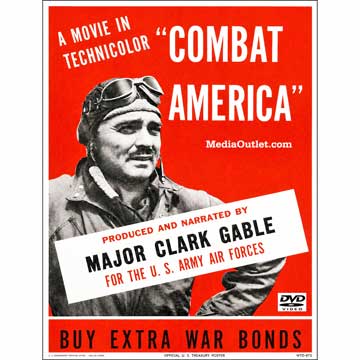
January 27, 1943: The European Civil War:
World War II: The Second European War (The European Theater Of
World War II): Air Warfare Of World War II: Strategic Bombing
During World War II: The Bombing Of Wilhelmshaven In World War II:
-- The U.S. 8th Air Force conducted the first all-American bombing
raid on Germany as 91 B-17 and B-24 heavy bombers attacked the
U-boat construction yards at Wilhelmshaven, losing three planes
while claiming to have shot down 22 German fighters. The success
of this first mission encouraged U.S. military planners to begin
regular daylight bombing raids, which eventually resulted in a
very high casualty rate for the American crewmen involved.
Hollywood movie star Clark Cable was an airman who participated in
this raid, and he served as a gunner on the B-17 he flew in, he
led a film crew who shot footage from this mission which appears
in his 1943 film COMBAT AMERICA. On Sale @ 15% Off Discount Till
Midnight PT!
https://store.earthstation1.com/combat-america-1945-clark-gable-8th-usaaf-wwi19458.html
Today's
EarthStation1.com 15% Off Commemorative Memorial Title: The
Bolshoi Ballet 2 Part TV Series DVD, Video Download, USB Drive
Today, January 27, 2026
January 27, 1948: #BOTD: #HBD! Mikhail
Baryshnikov, Russian-American dancer, choreographer, and actor, is
#born in Riga, Latvian SSR. Mikhail Nikolayevich Baryshnikov,
nicknamed "Misha" (Russian diminutive of the name
"Mikhail"), is often cited alongside Vaslav Nijinsky,
Rudolf Nureyev and Vladimir Vasiliev as one of the greatest male
ballet dancers in history. Born in Riga, Latvian SSR, Soviet
Union, Baryshnikov had a promising start in the Kirov Ballet in
Leningrad before defecting to Canada in 1974 for more
opportunities in western dance. After dancing with American Ballet
Theater, he joined the New York City Ballet as a principal dancer
for one season to learn George Balanchine's neo classical Russian
style of movement. He then returned with the American Ballet
Theatre, where he later became artistic director. Baryshnikov has
spearheaded many of his own artistic projects and has been
associated in particular with promoting modern dance, premiering
dozens of new works, including many of his own. His success as a
dramatic actor on stage, cinema and television has helped him
become probably the most widely recognized contemporary ballet
dancer. Since his defection from the Soviet Union in 1974,
Baryshnikov has never returned to Russia. In 1977, he received a
nomination for the Academy Award for Best Supporting Actor and a
Golden Globe nomination for his work as "Yuri Kopeikine"
in the film The Turning Point. He starred in the movie White
Nights with Gregory Hines, Helen Mirren, and Isabella Rossellini,
and had a significant role in the last season of the television
series Sex and the City. On Sale @ 15% Off Discount Till Midnight
PT!
https://store.earthstation1.com/the-bolshoi-ballet-complete-2-part-tv-documentary-series-dv2.html
Today's
EarthStation1.com 15% Off Commemorative Memorial Title: Outer
Space Films 12: The Apollo-Soyuz Test Project DVD MP4 USB Drive
Today, January 27, 2026
January 27, 1967: The History Of
Spaceflight: The Aftermath Of World War II: The Cold War: The
Space Age: The Space Race: The Politics Of Outer Space: The Outer
Space Treaty (OST) (The Treaty On Principles Governing The
Activities Of States In The Exploration And Use Of Outer Space,
Including The Moon And Other Celestial Bodies): -- The Outer Space
Treaty is signed by more than sixty nations, including the Soviet
Union, United States, and the United Kingdom, banning deployment
of nuclear weapons in space, and limiting the usage of the Moon
and other celestial bodies to peaceful purposes; it was signed on
the same day that three American astronauts, Gus Grissom, Ed White
and Roger Chaffee, were killed as a fire erupted inside their
Apollo 1 Command Module space craft during a launch simulation
ground test at the Kennedy Space Center, Florida. The Outer Space
Treaty, formally the Treaty on Principles Governing the Activities
of States in the Exploration and Use of Outer Space, including the
Moon and Other Celestial Bodies, is a multilateral treaty that
forms the basis of international space law. Negotiated and drafted
under the auspices of the United Nations, it went into force on
October 10, 1967. As of February 2022, 112 countries are parties
to the treaty - including all major spacefaring nations - and
another 23 are signatories. The Outer Space Treaty was spurred by
the development of intercontinental ballistic missiles (ICBMs) in
the 1950s, which could reach targets through outer space. The
Soviet Union's launch of Sputnik, the first artificial satellite,
in October 1957, followed by a subsequent arms race with the
United States, hastened proposals to prohibit the use of outer
space for military purposes. On October 17, 1963, the U.N. General
Assembly unanimously adopted a resolution prohibiting the
introduction of weapons of mass destruction in outer space.
Various proposals for an arms control treaty governing outer space
were debated during a General Assembly session in December 1966,
culminating in the drafting and adoption of the Outer Space Treaty
the following January. Key provisions of the Outer Space Treaty
include prohibiting nuclear weapons in space; limiting the use of
the Moon and all other celestial bodies to peaceful purposes;
establishing that space shall be freely explored and used by all
nations; and precluding any country from claiming sovereignty over
outer space or any celestial body. Although it forbids
establishing military bases, testing weapons and conducting
military maneuvers on celestial bodies, the treaty does not
expressly ban all military activities in space, nor the
establishment of military space forces or the placement of
conventional weapons in space. From 1968 to 1984, the OST birthed
four additional agreements: rules for activities on the Moon;
liability for damages caused by spacecraft; the safe return of
fallen astronauts; and the registration of space vehicles. OST
provided many practical uses and was the most important link in
the chain of international legal arrangements for space from the
late 1950s to the mid-1980s. OST was at the heart of a 'network'
of inter-state treaties and strategic power negotiations to
achieve the best available conditions for nuclear weapons world
security. The OST also declares that space is an area for free use
and exploration by all and "shall be the province of all
mankind". Drawing heavily from the Antarctic Treaty of 1961,
the Outer Space Treaty likewise focuses on regulating certain
activities and preventing unrestricted competition that could lead
to conflict. Consequently, it is largely silent or ambiguous on
newly developed space activities such as lunar and asteroid
mining. Nevertheless, the Outer Space Treaty is the first and most
foundational legal instrument of space law, and its broader
principles of promoting the civil and peaceful use of space
continue to underpin multilateral initiatives in space, such as
the International Space Station and the Artemis Program. On Sale @
15% Off Discount Till Midnight PT!
https://store.earthstation1.com/outer-space-films-12-the-apollosoyuz-test-project-dvd-mp4-usb-dr124.html
Today's
EarthStation1.com 15% Off Commemorative Memorial Title: Apollo 1:
Tragedy On Pad 34 Apollo One Disaster MP4 Video Download DVD
Today, January 27, 2026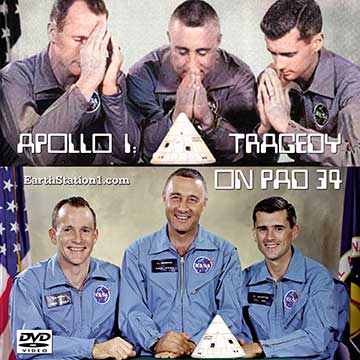
January 27, 1967: Spaceflight-Related Accidents And Incidents: The History Of Rocketry: The History Of Spaceflight: The Aftermath Of World War II: The Cold War: The Space Age: The Space Race: Space Programs Of The United States: Human Spaceflight Programs: Project Apollo: Apollo 1 (AS-204 (Initial, AS-1): -- #DOTD: #RIP: Apollo 1: Three American astronauts, Gus Grissom, Ed White and Roger Chaffee, were killed as a fire erupted inside their Apollo 1 Command Module space craft during a launch simulation ground test at the Kennedy Space Center, Florida, on the same day the Outer Space Treaty (OST) is signed. Gus Grissom and Roger Chaffee are buried at Arlington National Cemetery in Arlington, Virginia, where The Apollo 1 Monument is located honoring all three astronauts killed in The Apollo 1 Disaster; Ed White is buried at The United States Military Academy Post Cemetery at West Point, New York. Their deaths were NASA's first fatalites of their manned space program. Apollo 1, initially designated AS-204, was the first crewed mission of the United States Apollo program, the undertaking to land the first man on the Moon. It was planned to launch on 21 February 1967 as the first low Earth orbital test of the Apollo command and service module. The mission never flew; a cabin fire during a launch rehearsal test at Cape Kennedy Air Force Station Launch Complex 34 on January 27 killed all three crew members-Command Pilot Virgil I. "Gus" Grissom, Senior Pilot Ed White, and Pilot Roger B. Chaffee-and destroyed the command module (CM). The name Apollo 1, chosen by the crew, was made official by NASA in their honor after the fire. Immediately after the fire, NASA convened the Apollo 204 Accident Review Board to determine the cause of the fire, and both houses of the United States Congress conducted their own committee inquiries to oversee NASA's investigation. The ignition source of the fire was determined to be electrical, and the fire spread rapidly due to combustible nylon material, and the high pressure, pure oxygen cabin atmosphere. Rescue was prevented by the plug door hatch, which could not be opened against the internal pressure of the cabin. Because the rocket was unfueled, the test had not been considered hazardous, and emergency preparedness for it was poor. During the Congressional investigation, Senator Walter Mondale publicly revealed a NASA internal document citing problems with prime Apollo contractor North American Aviation, which became known as the Phillips Report. This disclosure embarrassed NASA Administrator James E. Webb, who was unaware of the document's existence, and attracted controversy to the Apollo program. Despite congressional displeasure at NASA's lack of openness, both congressional committees ruled that the issues raised in the report had no bearing on the accident. Crewed Apollo flights were suspended for 20 months while the command module's hazards were addressed. However, the development and uncrewed testing of the lunar module (LM) and Saturn V rocket continued. The Saturn IB launch vehicle for Apollo 1, SA-204, was used for the first LM test flight, Apollo 5. The first successful crewed Apollo mission was flown by Apollo 1's backup crew on Apollo 7 in October 1968. On Sale @ 15% Off Discount Till Midnight PT! https://store.earthstation1.com/ap1tronpad34.html
Today's
EarthStation1.com 15% Off Commemorative Memorial Title: War Props:
The Boeing B-29 Superfortress Heavy Bomber DVD, MP4, USB
Today, January 27, 2026
January 27, 1951: The Aftermath Of World
War II: The Cold War: Nuclear Warfare: Nuclear Weapons Testing:
American Nuclear Warfare: Nuclear Weapons Testing: Operation
Ranger: -- Nuclear testing at the Nevada Proving Grounds (now
known as the Nevada Test Site) begins with Operation Ranger.
Operation Ranger was the fourth American nuclear test series. It
was conducted in 1951 and was the first series to be carried out
at the Nevada Test Site. All the bombs were dropped by Boeing
B-50D Superfortress bombers and exploded in the open air over
Frenchman Flat (Area 5). These tests centered on the practicality
of developing a second generation of nuclear weapons using smaller
amounts of valuable nuclear materials. They were planned under the
name Operation Faust. The exact locations of the tests are
unknown, as they were all air drops. However, the planned ground
zero was set at 36dg 49'32min N 115dg 57'54 min W for all except
the Fox shot, which was "500 feet west and 300 feet south"
in order to minimize damage to the control point. The Nevada
National Security Site (N2S2 or NNSS), known as the Nevada Test
Site (NTS) until 2010, is a United States Department of Energy
(DOE) reservation located in southeastern Nye County, Nevada,
about 65 miles (105 km) northwest of the city of Las Vegas.
Formerly known as the Nevada Proving Grounds, the site was
established in 1951 for the testing of nuclear devices. It covers
approximately 1,360 square miles (3,500 km2) of desert and
mountainous terrain. Nuclear weapons testing at the site began
with a 1-kiloton-of-TNT (4.2 TJ) bomb dropped on Frenchman Flat on
January 27, 1951. Over the subsequent four decades, over 1,000
nuclear explosions were detonated at the site. Many of the iconic
images of the nuclear era come from the site. During the 1950s,
the mushroom clouds from the 100 atmospheric tests could be seen
from almost 100 mi (160 km) away. The city of Las Vegas
experienced noticeable seismic effects, and the mushroom clouds,
which could be seen from the downtown hotels, became tourist
attractions. Westerly winds routinely carried the fallout from
above-ground nuclear testing directly through St. George, Utah and
southern Utah. Increases in cancers, such as leukemia, lymphoma,
thyroid cancer, breast cancer, melanoma, bone cancer, brain
tumors, and gastrointestinal tract cancers, were reported from the
mid-1950s onward. A further 828 nuclear tests were carried out
underground. From 1986 through 1994, two years after the United
States put a hold on full-scale nuclear weapons testing, 536
anti-nuclear protests were held at the site, involving 37,488
participants and 15,740 arrests, according to government records.
The site contains 28 areas, 1,100 buildings, 400 miles (640 km) of
paved roads, 300 miles of unpaved roads, 10 heliports, and two
airstrips. Currently, Mission Support and Test Services (MSTS) is
the civilian contractor for the site's management and oversees
overall operations. MSTS manages and operates the site for the
National Nuclear Security Administration (NNSA). Security is
provided by SOC LLC. Footage of the Buster-Jangle Baker test is
often mislabeled as belonging to the Ranger Able test. Both shots
can be told apart because the Buster Baker test was conducted at
Yucca Flat in the daytime, meanwhile Ranger Able was conducted at
Frenchman Flat in the nighttime. No motion picture of Operation
Ranger has ever been declassified. On Sale @ 15% Off Discount Till
Midnight PT!
https://store.earthstation1.com/war-props-the-boeing-b29-superfortress-dvd-mp4-294.htmls
Today's
EarthStation1.com 15% Off Commemorative Memorial Title: Watergate:
The Secret Story With Mike Wallace DVD MP4 USB Flash Drive
Today, January 27, 2026
January 27, 1972: Scandals: Political
Scandals: Political Scandals Of The United States: Richard Nixon:
The Presidency Of Richard Nixon: The Watergate Scandal: Operation
Sandwedge: Operation Gemstone: The Watergate Break-In: --
Operation Gemstone, a detailed plan to break into Democratic Party
offices in the Watergate complex which was to result in what
became known as The Watergate Break-In and ultimately resulted in
The Watergate Scandal, begins. The Watergate Break-In was part of
Operation Sandwedge, a proposed clandestine intelligence-gathering
operation against the political enemies of U.S. President Richard
Nixon's administration. The proposals were put together by Nixon's
Chief of Staff H. R. Haldeman, domestic affairs assistant John
Ehrlichman and staffer Jack Caulfield in 1971. Caulfield, a former
police officer, created a plan to target the Democratic Party and
the anti-Vietnam War movement, inspired by what he believed to be
the Democratic Party's employment of a private investigation firm.
The operation was planned to help Nixon's 1972 re-election
campaign. Operation Sandwedge included proposed surveillance of
Nixon's enemies to gather information on their financial status
and sexual activities, to be carried out through illegal black bag
operations. The operation would have targeted not only the
anti-Vietnam war movement and the political opposition, but rivals
within Nixon's own Republican Party as well. Control of Sandwedge
was passed to G. Gordon Liddy, who abandoned it in favor of his
own strategy, Operation Gemstone, and on June 17, 1972, following
a seemingly routine burglary, five men were arrested at the
National Democratic Headquarters in the Watergate complex in
Washington, DC: James W. McCord Jr., Virgilio Gonzalez, Frank A.
Sturgis, Eugenio R. Martinez and Bernard L. Barker. Subsequent
investigations revealed the burglars were actually agents hired by
the Committee for the Re-election of President Richard Nixon under
their handlers E. Howard Hunt and G. Gordon Liddy. Liddy's plan
eventually led to long chain of events in which the president and
top aides became involved in an extensive coverup of this and
other White House sanctioned illegal activities, eventually
leading to the resignation of President Nixon on August 9, 1974,
which Caulfield believed would have been avoided had Sandwedge
been acted upon. Operation Gemstone was a proposed series of
clandestine or illegal acts, first outlined by G. Gordon Liddy in
two separate meetings with three other individuals: then-Attorney
General of the United States, John N. Mitchell, then-White House
Counsel John Dean, and Jeb Magruder, an ally and former aide to
H.R. Haldeman, as well as the temporary head of the Committee to
Re-elect the President, pending Mitchell's resignation as Attorney
General. The first meeting occurred in the Attorney General's
Washington, D.C., office at 11:00 a.m. on January 27, 1972. Liddy
described in great detail both his plan to disrupt the upcoming
Democratic National Convention in Miami Beach, Florida, and his
plan to prevent any disruption of the upcoming Republican National
Convention, then scheduled to take place in San Diego, California.
Liddy's proposals would cost approximately 1M USD to carry out
(Around 7M USD in 2022). Among the various elements of Gemstone
were plans to kidnap specific "radical" leaders, and
others who might cause trouble at the Republican Convention, and
hold them in Mexico until after the convention was over. According
to all four participants of the January 27 meeting, Attorney
General Mitchell declared, with some evident sarcasm, "Gordon,
that's not quite what I had in mind." John Dean described his
recollections of this meeting to President Nixon on March 21,
1973, during the "Cancer on the Presidency"
conversation: "So I came over and Liddy laid out a million
dollar plan that was the most incredible thing I have ever laid my
eyes on: all in codes, and involved black bag operations,
kidnapping, providing prostitutes, uh, to weaken the opposition,
bugging, uh, mugging teams. It was just an incredible thing."
The second meeting occurred one week later, on February 4, 1972,
again at Mitchell's office. The participants of this meeting were
the same four men as the first, although John Dean was not present
for the entire meeting. Dean himself later testified that he
arrived "very late" to the meeting. Liddy, Magruder, and
Mitchell all disputed this claim. At the February 4 meeting, Liddy
proposed a scaled-down plan that would cost 500K USD to enact
(Around 3.5M USD in 2022). While less ambitious than the January
27 agenda, "Operation Gemstone" still involved several
proposed criminal acts, most notably including the use of wiretaps
to eavesdrop on telephone conversations involving Democratic party
leaders. Beginning in April 1973, as the Watergate scandal began
to unravel, Magruder and Dean both gave public and private
testimony that was very damaging to John Mitchell. For his part,
Liddy remained silent until the publication of his memoir Will in
April 1980. However, all four men have publicly stated that the
February 4 meeting adjourned without Mitchell having expressed any
approval for any of Liddy's plans. More specifically, all four
participants have publicly agreed that the break-in of the
Democratic National Committee's Watergate offices, generally
considered the emblematic crime of the Watergate scandal, did not
come up in the meeting. On Sale @ 15% Off Discount Till Midnight
PT!
https://store.earthstation1.com/watergate-the-secret-story-with-mike-wallace-dvd-mp4-usb-flash-driv4.html
Today's
EarthStation1.com #OnThisDay Commemorative Memorial Title: WWII
Films: Industry & Labor Back The Attack! DVD, Download, USB
Drive
Today, January 27, 2026 January 27: Punch The Clock Day: -- A day
to recognize the 'punch the clock' system of clocking in and out
of work. Other names for the punch clock include time clock, time
recorder, or clock card machine. Most companies have moved away
from the original mechanical time clock to computer-based ones
that use smartphone or tablet technology. But the concept is still
very much applicable, and while we'll admit that it is one of the
more random holidays, it is more important than we realize.
Without the invention of the punch clock, the work lives of hourly
wagers would be different than the ones we know today.
Historically, hourly wages were calculated based on manual data
kept by employers. Managers would write down records of hours
worked by employees and determine payroll accordingly. This,
however, left a lot of room for miscalculation, workplace
disputes, and discrepancies in the money paid and money owed.
Employers could write down fewer hours to pay less, and employees
could claim they worked more to get paid more, with no secondary
source to double-check. Then came the Punch the Clock system.
Following the invention of the time clock in 1888, an
industrialist, Willard Le Grand Bundy, invented a clock where
employees could punch in and punch out the hours they worked. An
employee would punch their card into the clock, with their exact
work hours logged onto it. For the most part, this eliminated room
for foul play and mistrust in the workplace. Employees got paid
what they earned, and employers only paid what they owed, a
revolutionary change in hourly-wage workplaces. Over time, this
system has become even more advanced. Due to technological
advancements, wage calculating systems have become digitized and
more secure and accurate than ever. Employers can invest in
software that tracks employees' hours on their computers,
biometric trackers that store employees' handprints and eliminate
proxy punching, scan unique barcodes on identification cards, and
so much more. None of these advancements would have been possible
without the invention of the Punch the Clock system, and it paved
the way for more reliable, accurate methods of tracking hours
worked. On Sale @ 15% Off Discount Till Midnight PT!
https://store.earthstation1.com/wwii-films-industry-amp-labor-back-the-attack-dvd.html
January 27: Punch The Clock Day: -- A day
to recognize the 'punch the clock' system of clocking in and out
of work. Other names for the punch clock include time clock, time
recorder, or clock card machine. Most companies have moved away
from the original mechanical time clock to computer-based ones
that use smartphone or tablet technology. But the concept is still
very much applicable, and while we'll admit that it is one of the
more random holidays, it is more important than we realize.
Without the invention of the punch clock, the work lives of hourly
wagers would be different than the ones we know today.
Historically, hourly wages were calculated based on manual data
kept by employers. Managers would write down records of hours
worked by employees and determine payroll accordingly. This,
however, left a lot of room for miscalculation, workplace
disputes, and discrepancies in the money paid and money owed.
Employers could write down fewer hours to pay less, and employees
could claim they worked more to get paid more, with no secondary
source to double-check. Then came the Punch the Clock system.
Following the invention of the time clock in 1888, an
industrialist, Willard Le Grand Bundy, invented a clock where
employees could punch in and punch out the hours they worked. An
employee would punch their card into the clock, with their exact
work hours logged onto it. For the most part, this eliminated room
for foul play and mistrust in the workplace. Employees got paid
what they earned, and employers only paid what they owed, a
revolutionary change in hourly-wage workplaces. Over time, this
system has become even more advanced. Due to technological
advancements, wage calculating systems have become digitized and
more secure and accurate than ever. Employers can invest in
software that tracks employees' hours on their computers,
biometric trackers that store employees' handprints and eliminate
proxy punching, scan unique barcodes on identification cards, and
so much more. None of these advancements would have been possible
without the invention of the Punch the Clock system, and it paved
the way for more reliable, accurate methods of tracking hours
worked. On Sale @ 15% Off Discount Till Midnight PT!
https://store.earthstation1.com/wwii-films-industry-amp-labor-back-the-attack-dvd.html
Today's
EarthStation1.com #OnThisDay Commemorative Memorial Title: The
Romantic Spirit TV Series DVD, Video Download, USB Flash Drive
Today, January 27, 2026January 27, 1901: #DOTD: #RIP: Giuseppe
Verdi, Italian opera composer (b. October 10, 1813) #dies of a
stroke at the Grand Hotel et de Milan aged 87. He is buried at the
Casa Di Riposi Per Musicisti (Italian: "Rest Home For
Musicians"), a home for retired opera singers and musicians
that Verdi founded in Milan, northern Italy. The building was
designed in the neo-Gothic style by Italian architect, Camillo
Boito. Both Verdi and his wife, Giuseppina Strepponi are buried
there. Giuseppe Fortunino Francesco Verdi was #born near Busseto
to a provincial family of moderate means, and developed a musical
education with the help of a local patron. Verdi came to dominate
the Italian opera scene after the era of Vincenzo Bellini, Gaetano
Donizetti, and Gioachino Rossini, whose works significantly
influenced him. In his early operas, Verdi demonstrated a sympathy
with the Risorgimento movement which sought the unification of
Italy. He also participated briefly as an elected politician. The
chorus "Va, pensiero" from his early opera Nabucco
(1842), and similar choruses in later operas, were much in the
spirit of the unification movement, and the composer himself
became esteemed as a representative of these ideals. An intensely
private person, Verdi, however, did not seek to ingratiate himself
with popular movements and as he became professionally successful
was able to reduce his operatic workload and sought to establish
himself as a landowner in his native region. He surprised the
musical world by returning, after his success with the opera Aida
(1871), with three late masterpieces: his Requiem (1874), and the
operas Otello (1887) and Falstaff (1893). His operas remain
extremely popular, especially the three peaks of his 'middle
period': Rigoletto, Il trovatore and La traviata, and the 2013
bicentenary of his birth was widely celebrated in broadcasts and
performances. On Sale @ 15% Off Discount Till Midnight PT!
https://store.earthstation1.com/the-romantic-spirit-tv-series-all-14-episodes-5-dual-layer-d145.html
Today's
EarthStation1.com #OnThisDay Commemorative Memorial Title: The
Weavers: Wasn't That A Time! DVD, Video Download, USB Flash Drive
Today, January 27, 2026January 27, 2014: #DOTD: #RIP: Pete
Seeger, American singer-songwriter, guitarist, and activist (The
Weavers and Almanac Singers) (b. May 3, 1919) #dies of natural
causes at New York-Presbyterian Hospital in New York City at the
age of 94.. A fixture on nationwide radio in the 1940s, Pete
Seeger also had a string of hit records during the early 1950s as
a member of the Weavers, most notably their recording of Lead
Belly's "Goodnight, Irene", which topped the charts for
13 weeks in 1950. Members of the Weavers were blacklisted during
the McCarthy Era. In the 1960s, Seeger re-emerged on the public
scene as a prominent singer of protest music in support of
international disarmament, civil rights, counterculture, and
environmental causes. A prolific songwriter, his best-known songs
include "Where Have All the Flowers Gone?" (with Joe
Hickerson), "If I Had a Hammer (The Hammer Song)" (with
Lee Hays of the Weavers), and "Turn! Turn! Turn!", which
have been recorded by many artists both in and outside the folk
revival movement. "Flowers" was a hit recording for the
Kingston Trio (1962); Marlene Dietrich, who recorded it in
English, German and French (1962); and Johnny Rivers (1965). "If
I Had a Hammer" was a hit for Peter, Paul and Mary (1962) and
Trini Lopez (1963) while the Byrds had a number one hit with
"Turn! Turn! Turn!" in 1965. Seeger was one of the folk
singers responsible for popularizing the spiritual "We Shall
Overcome" (also recorded by Joan Baez and many other
singer-activists) that became the acknowledged anthem of the Civil
Rights Movement. On Sale @ 15% Off Discount Till Midnight PT!
https://store.earthstation1.com/the-weavers-wasn39t-that-a-time-dvd-1981-docum391981.html
Today's
EarthStation1.com #OnThisDay Commemorative Memorial Title: Rowan &
Martin's Laugh-In MegaSet 2 Albums 2 Blooper Sets MP3 MP4 DVD
Today, January 27, 2026January 27, 1927: #BOTD: #HBD! Billy
Barnes, composer, lyricist and actor (d. September 25, 2012) is
#born in Los Angeles, California. Barnes started writing musical
comedy sketches while still in high school, and continued while at
UCLA. He started collaborating in college with Bob Rodgers, and
their first professional musical comedy revue, a Cabaret Concert
Show, was staged in 1956 in Los Angeles. Barnes continued with
theatrical revues, including The Billy Barnes Revue, Billy Barnes'
People, Billy Barnes' Party, Billy Barnes' L.A., and Billy Barnes'
Hollywood. Other productions with Barnes' songs include Movie
Star, and Blame It on the Movies (1988). For television, Barnes
wrote special material and original musical production numbers for
Rowan & Martin's Laugh-In, The Danny Kaye Show, The Sonny and
Cher Comedy Hour, Cher and The Carol Burnett Show. He wrote
opening production numbers for several Academy Awards telecasts.
He has composed comedic and topical songs for many of show
business's greatest personalities including Lucille Ball, Bette
Davis and Angela Lansbury. He wrote the songs for the 1976
television musical adaptation of Pinocchio starring Sandy Duncan.
Barnes may be best known for his theatrical revues and his
recurring role as Mr. Edlin on the television series Mad About
You. On Sale @ 15% Off Discount Till Midnight PT!
https://store.earthstation1.com/rowan-and-martin-discount-set-2-albums-2-blooper-reel-sets-mp3-mp4-dvd.html
Today's
EarthStation1.com #OnThisDay Commemorative Memorial Title: WABC Radio
Airchecks MP3 Collection 1960s-1980s DVD, MP3 Download, USB
Today, January 27, 2026January 27, 1930: #BOTD: #HBD! Bobby
Bland, African American blues singer and songwriter known
professionally as Bobby "Blue" Bland (d. June 23, 2013)
is #born Robert Calvin Bland (ne Robert Calvin Brook) in the small
town of Barretville, Tennessee. His father, I. J. Brooks,
abandoned the family not long after Robert's birth. Robert later
acquired the name "Bland" from his stepfather, Leroy
Bridgeforth, who was also called Leroy Bland. Robert dropped out
of school in third grade to work in the cotton fields and never
graduated from school. Known professionally as Bobby "Blue"
Bland, developed a sound that mixed gospel with the blues and R &
B. He was described as "among the great storytellers of blues
and soul music... [who] created tempestuous arias of love,
betrayal and resignation, set against roiling, dramatic
orchestrations, and left the listener drained but awed." He
was sometimes referred to as the "Lion of the Blues" and
as the "Sinatra of the Blues". His music was also
influenced by Nat King Cole. Bland was inducted into the Blues
Hall of Fame in 1981, the Rock and Roll Hall of Fame in 1992, and
the Memphis Music Hall of Fame in 2012. He received the Grammy
Lifetime Achievement Award in 1997. The Rock and Roll Hall of Fame
described him as "second in stature only to B.B. King as a
product of Memphis's Beale Street blues scene". Bobby Bland
died at his home in Germantown, Tennessee, a suburb of Memphis,
after what family members described as "an ongoing illness",
aged 83. He is interred at Memorial Park Cemetery in Memphis. On
Sale @ 15% Off Discount Till Midnight PT!
https://store.earthstation1.com/wabc-musicradio-shows-mp3-dvd-60s80s-am-360807775.html
Today's
EarthStation1.com #OnThisDay Commemorative Memorial Title: Music
Documentaries I DVD, MP4 Video Download, USB Flash Drive
Today, January 27, 2026January 27, 1944: #BOTD: #HBD! Nick
Mason, English drummer, composer, songwriter, record producer,
author, auto racer and founding member of the progressive rock
band Pink Floyd, is #born Nicholas Berkeley Mason in Edgbaston,
Birmingham, England, the son of English documentary film maker and
scriptwriter Bill Mason. Nicholas Berkeley Mason, CBE is the only
member to feature on every Pink Floyd album, and the only constant
member since its formation in 1965. He co-wrote Pink Floyd
compositions such as "Echoes", "Time",
"Careful With That Axe, Eugene" and "One of These
Days". In 2018, he formed a new band, Nick Mason's Saucerful
of Secrets, to perform music from Pink Floyd's early years. On
Sale @ 15% Off Discount Till Midnight PT!
https://store.earthstation1.com/music-documentaries-dvd-clapton-pink-floyd-zappa-glass-jazz.html
Today's
EarthStation1.com #OnThisDay Commemorative Memorial Title: Cavalcade
Of America US History Radio Drama Series DVD, Download, USB
Today, January 27, 2026January 27, 1851: #DOTD: #RIP: John James
Audubon, French-African American self-trained artist, naturalist,
and ornithologist (b. April 26, 1785) #dies at his family home in
northern Manhattan, aged 65. Audubon is buried in the graveyard at
the Church of the Intercession in the Trinity Church Cemetery and
Mausoleum at 155th Street and Broadway in Manhattan, near his
home. An imposing monument in his honor was erected at the
cemetery, which is now recognized as part of the Heritage Rose
District of NYC. Audubon's final work dealt with mammals; he
prepared The Viviparous Quadrupeds of North America (1845-1849) in
collaboration with his good friend Rev. John Bachman of
Charleston, South Carolina, who supplied much of the scientific
text. His son, John Woodhouse Audubon, drew most of the plates.
The work was completed by Audubon's sons, and the second volume
was published posthumously in 1851. John James Audubon was born
Jean-Jacques Rabin in Les Cayes in the French colony of
Saint-Domingue (now Haiti) on his father's sugarcane plantation,
the son of Lieutenant Jean Audubon, a French naval officer and
privateer, and his chambermaid mistress of French and African
descent Jeanne Rabine, after whom he was named. In honor of his
birthday, Audubon Day on April 26 each year commemorates his work
towards conservation activities, and also recognizes the crucial
work done by The National Audubon Society. John James Audubon
combined interests in art and ornithology turned into a plan to
make a complete pictorial record of all the bird species of North
America. He was notable for his extensive studies documenting all
types of American birds and for his detailed illustrations, which
depicted the birds in their natural habitats. His major work, a
color-plate book titled The Birds of America (1827-1839), is
considered one of the finest ornithological works ever completed.
Audubon is also known for identifying 25 new species. He is the
eponym of the National Audubon Society, and his name adorns a
large number of towns, neighborhoods, and streets across the
United States. Dozens of scientific names first published by
Audubon are still in use by the scientific community. Audubon made
some excursions out West where he hoped to record Western species
he had missed, but his health began to fail. In 1848, he
manifested signs of senility or possibly dementia from what is now
called Alzheimer's disease, his "noble mind in ruins".
On Sale @ 15% Off Discount Till Midnight PT!
https://store.earthstation1.com/cavalcade-of-america-historical-old-time-radio-mp3-dv3.html
Today's
EarthStation1.com #OnThisDay Commemorative Memorial Title: Monarchy
In The UK: British Royal History MP4 Video Download DVD Set
Today, January 27, 2026January 27, 1606: The Gunpowder Plot (The
Gunpowder Plot Of 1605, The Gunpowder Treason Plot, The Jesuit
Treason): -- The trial of Guy Fawkes and other Gunpowder Plot
conspirators begins, ending with their execution on January 31.
The Gunpowder Plot was a failed assassination attempt against King
James I by a group of provincial English Catholics led by Robert
Catesby who sought to restore the Catholic monarchy to England
after decades of persecution against Catholics. The plan was to
blow up the House of Lords during the State Opening of Parliament
on November 5, 1605, as the prelude to a popular revolt in the
Midlands during which King James's nine-year-old daughter,
Elizabeth, was to be installed as the Catholic head of state.
Catesby may have embarked on the scheme after hopes of securing
greater religious tolerance under King James I had faded, leaving
many English Catholics disappointed. His fellow conspirators were
John and Christopher Wright, Robert and Thomas Wintour, Thomas
Percy, Guy Fawkes, Robert Keyes, Thomas Bates, John Grant, Ambrose
Rookwood, Sir Everard Digby and Francis Tresham. Fawkes, who had
10 years of military experience fighting in the Spanish
Netherlands in the failed suppression of the Dutch Revolt, was
given charge of the explosives. The plot was revealed to the
authorities in an anonymous letter sent to William Parker, 4th
Baron Monteagle, on 26 October 1605. During a search of the House
of Lords in the evening on 4 November 1605, Fawkes was discovered
guarding 36 barrels of gunpowder-enough to reduce the House of
Lords to rubble-and arrested. Most of the conspirators fled from
London as they learned that the plot had been discovered, trying
to enlist support along the way. Several made a stand against the
pursuing Sheriff of Worcester and his men at Holbeche House; in
the ensuing battle Catesby was one of those shot and killed. At
their trial on 27 January 1606, eight of the survivors, including
Fawkes, were convicted and sentenced to be hanged, drawn and
quartered. Details of the assassination attempt were allegedly
known by the principal Jesuit of England, Father Henry Garnet SJ.
Although he was convicted of treason and sentenced to death, doubt
has been cast on how much he really knew of the plot. As its
existence was revealed to him through confession, Garnet was
prevented from informing the authorities by the absolute
confidentiality of the confessional. Although anti-Catholic
legislation was introduced soon after the discovery of the plot,
many important and loyal Catholics retained high office during
King James I's reign. The thwarting of the Gunpowder Plot was
commemorated for many years afterwards by special sermons and
other public events such as the ringing of church bells, which
evolved into the British variant of Bonfire Night of today. On
Sale @ 15% Off Discount Till Midnight PT!
https://store.earthstation1.com/monarchy-in-the-uk-british-royal-history-mp4-video-download-dvd-set.html
Today's
EarthStation1.com #OnThisDay Commemorative Memorial Title: Manfred
von Richthofen The Red Baron & WWI Aviation DVD, Download, USB
Today, January 27, 2026January 27, 1989: #DOTD: #RIP: Sir Thomas
Sopwith, Commander Of The British Empire (CBE), Honary Fellow Of
The Royal Aeronatical Society (Hon FRAeS), English Aviation
Pioneer, ice hockey player, sailor, yachtsman and businessman,
whose Sopwith Camel fighter aircraft became one of the most iconic
fighter aircraft of the First World War and the plane was
responsible for shooting down the Red Baron (b. January 18, 1888)
#dies in Hampshire on nine days after his 101st birthday. His
grave and that of his second wife (Phyllis Brodie) are in the
churchyard of All Saints Church, Little Somborne, near Winchester.
Sir Thomas Sopwith was born Thomas Octave Murdoch Sopwith in
Kensington, London, England. Sopwith became interested in flying
after seeing John Moisant flying the first cross-Channel passenger
flight. His first flight was with Gustave Blondeau in a Farman at
Brooklands. He soon taught himself to fly on a Howard Wright Avis
monoplane and took to the air on his own for the first time on
October 22, 1910. He crashed after travelling about 300 yards (275
m), but soon improved, and on 22 November was awarded Royal Aero
Club Aviation Certificate No. 31, flying a Howard Wright 1910
Biplane. On December 18, 1910, Sopwith won a 4000GBP prize for the
longest flight from England to the Continent in a British-built
aeroplane, flying 169 miles in 3 hours 40 minutes. He used the
winnings to set up the Sopwith School of Flying at Brooklands. In
June 1912 Sopwith with Fred Sigrist and others set up the Sopwith
Aviation Company, initially at Brooklands. On October 24, 1912
using a Wright Model B completely rebuilt by Sopwith and fitted
with an ABC 40 hp engine, Harry Hawker took the British Michelin
Endurance prize with a flight of 8h 23m. Sopwith Aviation got its
first military aircraft order in November 1912, and in December
moved to larger premisies in Kingston upon Thames. The company
produced more than 18,000 British World War I aircraft for the
allied forces, including 5747 of the Sopwith Camel single-seat
fighter. Sopwith was awarded the CBE in 1918. Bankrupted after the
war by punitive anti-profiteering taxes, he re-entered the
aviation business a few years later with a new firm named after
his chief engineer and test pilot, Harry Hawker. Sopwith became
chairman of the new firm, Hawker Aircraft. After the
nationalisation of the aviation interests of what was by then
Hawker Siddeley, he continued to work as a consultant to the
company until 1980. Sopwith's 100th birthday was marked by a
flypast of military aircraft over his home, Compton Manor in
King's Somborne, Hampshire. On Sale @ 15% Off Discount Till
Midnight PT!
https://store.earthstation1.com/red-baron-dvd-world-war-i-aerial-warfare-documentaries.html
Today's
EarthStation1.com #OnThisDay Commemorative Memorial Title: Edison's
Miracle Of Light History Peter Coyote MP4 Video Download DVD
Today, January 27, 2026January 27, 1880: Lighting
(Illumination): The History Of Lighting: Electric Light: The
History Of Electric Light: Incandescent Lighting: The History Of
Incandescent Lighting: -- Thomas Edison receives a patent for his
design for an incandescent light bulb which he applied for on
October 21, 1879, the same date on which he hours later
successfully tested an electric incandescent lamp with a
carbonized filament at his laboratory in Menlo Park, New Jersey,
keeping it lit for over 13 hours into the next day, the first
electric light. An incandescent light bulb, incandescent lamp or
incandescent light globe is an electric light with a wire filament
heated until it glows. The filament is enclosed in a bulb to
protect the filament from oxidation. Current is supplied to the
filament by terminals or wires embedded in the glass. A bulb
socket provides mechanical support and electrical connections.
Incandescent bulbs are manufactured in a wide range of sizes,
light output, and voltage ratings, from 1.5 volts to about 300
volts. They require no external regulating equipment, have low
manufacturing costs, and work equally well on either alternating
current or direct current. As a result, the incandescent bulb
became widely used in household and commercial lighting, for
portable lighting such as table lamps, car headlamps, and
flashlights, and for decorative and advertising lighting.
Incandescent bulbs are much less efficient than other types of
electric lighting, converting less than 5% of the energy they use
into visible light. The remaining energy is lost as heat. The
luminous efficacy of a typical incandescent bulb for 120 V
operation is 16 lumens per watt, compared with 60 lm/W for a
compact fluorescent bulb or 150 lm/W for some white LED lamps.
Some applications use the heat generated by the filament. Heat
lamps are made for uses such as incubators, lava lamps, and the
Easy-Bake Oven toy. Quartz tube lamps are used for industrial
processes such as paint curing or for space heating. Incandescent
bulbs typically have short lifetimes compared with other types of
lighting; around 1,000 hours for home light bulbs versus typically
10,000 hours for compact fluorescents and 20,000-30,000 hours for
lighting LEDs. Incandescent bulbs can be replaced by fluorescent
lamps, high-intensity On Sale @ 15% Off Discount Till Midnight PT!
https://store.earthstation1.com/edmioflihipe.html
Today's
EarthStation1.com #OnThisDay Commemorative Memorial Title: War Props:
The Lockheed P-38 Lightning DVD, MP4 Download, USB Drive
Today, January 27, 2026January 27, 1939 The History Of Aviation:
The History Of Military Aviation: Maiden Flights: -- Test pilot
Ben Kelsey flies the Lockheed XP-38, prototype of the Lockheed
P-38, for the first time. Construction had begun in July 1938 in
an old bourbon distillery purchased by Lockheed to house expanding
operations. This secure and remote site was later identified by
Johnson as the first of five Lockheed Skunk Works locations. The
Lockheed P-38 Lightning is an American single-seated, twin
piston-engined fighter aircraft that was used during World War II.
Developed for the United States Army Air Corps by the Lockheed
Corporation, the P-38 incorporated a distinctive twin-boom design
with a central nacelle containing the cockpit and armament. Allied
propaganda claimed it had been nicknamed the fork-tailed devil
(German: der Gabelschwanz-Teufel) by the Luftwaffe and "two
planes, one pilot" by the Japanese. Along with its use as a
general fighter, the P-38 was used in various aerial combat roles,
including as a highly effective fighter-bomber, a night fighter,
and a long-range escort fighter when equipped with drop tanks. The
P-38 was also used as a bomber-pathfinder, guiding streams of
medium and heavy bombers, or even other P-38s, equipped with
bombs, to their targets. Used in the aerial reconnaissance role,
the P-38 accounted for 90% of the aerial film captured over
Europe. The P-38 was used most successfully in the Pacific Theater
of Operations and the China-Burma-India Theater of Operations as
the aircraft of America's top aces, Richard Bong (40 victories),
Thomas McGuire (38 victories), and Charles H. MacDonald (27
victories). In the South West Pacific theater, the P-38 was the
primary long-range fighter of United States Army Air Forces until
the introduction of large numbers of P-51D Mustangs toward the end
of the war. Unusual for an early-war fighter design, both engines
were supplemented by turbosuperchargers, granting the P-38
excellent high-altitude performance, making it one of the earliest
Allied fighters capable of performing well at high altitudes. The
turbosuperchargers also muffled the exhaust, making the P-38's
operation relatively quiet. The Lightning was extremely forgiving
in-flight and could be mishandled in many ways, but the rate of
roll in early versions was low relative to other contemporary
fighters; this was addressed in later variants with the
introduction of hydraulically boosted ailerons. The P-38 was the
only American fighter aircraft in large-scale production
throughout American involvement in the war, from the Attack on
Pearl Harbor to Victory over Japan Day. On Sale @ 15% Off Discount
Till Midnight PT!
https://store.earthstation1.com/war-props-the-p38-lightning-d38.html
Today's
EarthStation1.com #OnThisDay Commemorative Memorial Title: The Story
Of Civilization: Will & Ariel Durant DVD, MP3 Download, USB
Today, January 27, 2026January 27, AD 98: Rome: Ancient Rome:
The Roman Empire: Royal Accessions: Successions To The Throne Of
The Roman Empire: -- Trajan succeeds as Roman emperor upon the
death of his adoptive father Emperor Nerva. ========= #DOTD: #RIP:
Nerva (originally Marcus Cocceius Nerva; November 8, 30 - January
27, 98) was Roman emperor from 96 to 98. Nerva became emperor when
aged almost 66, after a lifetime of imperial service under Nero
and the rulers of the Flavian dynasty. Under Nero, he was a member
of the imperial entourage and played a vital part in exposing the
Pisonian conspiracy of 65. Later, as a loyalist to the Flavians,
he attained consulships in 71 and 90 during the reigns of
Vespasian and Domitian, respectively. On September 18, 96,
Domitian was assassinated in a palace conspiracy involving members
of the Praetorian Guard and several of his freedmen. On the same
day, Nerva was declared emperor by the Roman Senate. As the new
ruler of the Roman Empire, he vowed to restore liberties which had
been curtailed during the autocratic government of Domitian.
Nerva's brief reign was marred by financial difficulties and his
inability to assert his authority over the Roman army. A revolt by
the Praetorian Guard in October 97 essentially forced him to adopt
an heir. After some deliberation Nerva adopted Trajan, a young and
popular general, as his successor. After barely fifteen months in
office, Nerva died of natural causes on January 27, 98. Upon his
death he was succeeded and deified by Trajan. Although much of his
life remains obscure, Nerva was considered a wise and moderate
emperor by ancient historians. Nerva's greatest success was his
ability to ensure a peaceful transition of power after his death
by selecting Trajan as his heir, thus founding the Nerva-Antonine
dynasty. ========= Trajan (Imperator Caesar Nerva Traianus Divi
Nervae filius Augustus; September 18, 53 - August 8, 117 AD) was
Roman emperor from 98 to 117 AD. Officially declared by the Senate
optimus princeps ("the best ruler"), Trajan is
remembered as a successful soldier-emperor who presided over the
greatest military expansion in Roman history, leading the empire
to attain its maximum territorial extent by the time of his death.
He is also known for his philanthropic rule, overseeing extensive
public building programs and implementing social welfare policies,
which earned him his enduring reputation as the second of the Five
Good Emperors who presided over an era of peace and prosperity in
the Mediterranean world. Born in the city of Italica in the
province of Hispania Baetica (modern day Spain), Trajan's
non-patrician family was of Italian and Iberian origin. Trajan
rose to prominence during the reign of emperor Domitian. In 89
Trajan supported Domitian against a revolt on the Rhine led by
Antonius Saturninus. In September 96, Domitian was succeeded by
Marcus Cocceius Nerva, an old and childless senator who proved to
be unpopular with the army. After a brief and tumultuous year in
power, culminating in a revolt by members of the Praetorian Guard,
Nerva was compelled to adopt the more popular Trajan as his heir
and successor. He died on 27 January 98 and was succeeded by his
adopted son without incident. As a civilian administrator, Trajan
is best known for his extensive public building program, which
reshaped the city of Rome and left numerous enduring landmarks
such as Trajan's Forum, Trajan's Market and Trajan's Column. Early
in his reign, he annexed the Nabataean Kingdom, creating the
province of Arabia Petraea. His conquest of Dacia enriched the
empire greatly, as the new province possessed many valuable gold
mines. Trajan's war against the Parthian Empire ended with the
sack of the capital Ctesiphon and the annexation of Armenia and
Mesopotamia. His campaigns expanded the Roman Empire to its
greatest territorial extent. In late 117, while sailing back to
Rome, Trajan fell ill and died of a stroke in the city of Selinus.
He was deified by the Senate and his ashes were laid to rest under
Trajan's Column. He was succeeded by his adopted son Hadrian. On
Sale @ 15% Off Discount Till Midnight PT!
https://store.earthstation1.com/story-of-civilization-will-amp-ariel-durant-mp3-dvd-11-audiobo311.html
Today's
EarthStation1.com #OnThisDay Commemorative Memorial Title: Decades:
The 1960s TV Series DVD, Video Download, USB Flash Drive
Today, January 27, 2026January 27, 2008: #DOTD: Suharto (or
Soeharto), Indonesian soldier, politician, military dictator and
political mass murderer, 2nd and the longest serving President Of
Indonesia (b. June 8, 1921) #dies after a protracted period of ill
health. On January 4, 2008, Suharto was taken to the Pertamina
Central Hospital, Jakarta with complications arising from poor
health, swelling of limbs and stomach, and partial renal failure.
His health fluctuated for several weeks but progressively worsened
with anaemia and low blood pressure due to heart and kidney
complications, internal bleeding, fluid on his lungs, and blood in
his faeces and urine which caused a haemoglobin drop. On January
23, Suharto's health worsened further, as a sepsis infection
spread through his body. His family consented to the removal of
life support machines if his condition did not improve, and he
died on January 27 at 1:09 pm. He is buried in Astana Giribangun
(also "Giri Bangun"), a mausoleum complex for the
Suharto's family of the former President of Indonesia, located in
Karang Bangun, Matesih, Karanganyar Regency, Central Java
province. It is on the slopes of Mount Lawu, approximately 35
kilometres east of the city of Surakarta. The archaic Javanese
name translates as "Palace of the risen mountain".
Minutes after his death, then-Indonesian President Susilo Bambang
Yudhoyono held a news conference declaring Suharto as one of
Indonesia's "best sons" and invited the country to give
the highest respect and honour to the ex-president. Suharto's body
was taken from Jakarta to the Astana Giribangun mausoleum complex
in Karanganyar Regency, near the Central Java city of Solo. He was
buried alongside his late wife in a state military funeral with
full honours, with the Kopassus elite forces and KOSTRAD commandos
as the honour guard and pallbearers and Commander of Group II
Kopassus Surakarta Lt. Colonel Asep Subarkah. In attendance were
President Yudhoyono, who presided over the ceremony, as well as
the vice-president, government ministers, and armed forces chiefs
of staff. Tens of thousands of people lined the streets to see the
convoy. Condolences were offered by many regional heads of state.
President Yudhoyono that afternoon declared a week of official
mourning starting from Suharto's day of death. During this period,
all flags of Indonesia were flown at half-mast. Suharto was born
Haji Muhammad Suharto to ethnic Javanese parents in a
plaited-bamboo-walled house in the Java hamlet of Kemusuk, a part
of the larger village of Godean in the administrative divisions of
the Dutch East Indies of Bantoel Regentschap, 15 kilometres (9 mi)
west of Yogyakarta, the cultural heartland of the Javanese, in the
Yogyakarta Sultanate, then part of the Dutch East Indies. Like
many Javanese, Suharto had only one name. Religious contexts in
recent years have sometimes called him as "Haji" or
"Al-Haj Mohammed Suharto", but these names were not part
of his formal name nor generally used. The spelling "Suharto"
reflects modern Indonesian orthography, although the general
approach in Indonesia is to rely on the spelling preferred by the
person concerned. At the time of his birth, the standard
transcription was "Soeharto", and he used the original
spelling throughout his life. The international English-language
press generally uses the spelling 'Suharto' while the Indonesian
government and media use 'Soeharto'. He was the second President
of Indonesia, holding the office for 31 years from the ousting of
Sukarno in 1967 until his resignation in 1998. During the Japanese
occupation of Indonesia, Suharto served in Japanese-organised
Indonesian security forces. Indonesia' independence struggle saw
his joining the newly formed Indonesian army. Suharto rose to the
rank of major general following Indonesian independence. An
attempted coup on September 30, 1965 allegedly backed by the
Indonesian Communist Party was countered by Suharto-led troops.
The army subsequently led an anti-communist purge which the CIA
described as "one of the worst mass murders of the 20th
century" resulting in between 400,000 and 3,000,000 deaths
after Suharto wrested power from Indonesia's founding president,
Sukarno. With Suharto increasingly seen as the source of the
country's mounting economic and political crises, prominent
political figures, including Muslim politician Amien Rais, spoke
out against his presidency, and in January 1998 university
students began organizing nationwide demonstrations. The crisis
climaxed while Suharto was on a state visit to Egypt on May 12,
1998, when security forces killed four demonstrators from
Jakarta's Trisakti University. Rioting and looting across Jakarta
and other cities over the following days destroyed thousands of
buildings and killed over 1,000 people. Ethnic Chinese and their
businesses were particular targets in the violence. Theories on
the origin of the violence include rivalry between military chief
General Wiranto and Army Strategic Commander Lt. Gen. Prabowo
Subianto, and the suggestion of deliberate provocation by Suharto
to divert blame for the crisis to the ethnic-Chinese and discredit
the student movement. On May 16, tens of thousands of university
students demanded Suharto's resignation, and occupied the grounds
and roof of the parliament building. Upon Suharto's return to
Jakarta, he offered to resign in 2003 and to reshuffle his
cabinet. These efforts failed when his political allies deserted
him by refusing to join the proposed new cabinet. According to
Wiranto, on May 18, Suharto issued a decree which provided
authority to him to take any measures to restore security;
however, Wiranto decided not to enforce the decree to prevent
conflict with the population. On May 21, 1998, Suharto announced
his resignation, upon which vice-president Habibie assumed the
presidency in accordance with the constitution. Documents from the
United States Department of State indicate that the Clinton
Administration sought to maintain close ties with the Indonesian
military in the aftermath of Suharto's fall from power. After
resigning from the presidency, Suharto became a recluse in his
family's compound in the Menteng area of Jakarta, protected by
soldiers and rarely making public appearances. Suharto's family
spent much of their time fending off corruption investigations.
However, Suharto himself was protected from grave prosecution by
politicians who owed their positions to the former president, as
indicated in the leaked telephone conversation between President
Habibie and attorney-general Andi Muhammad Ghalib in February
1999. In May 1999, Time Asia estimated Suharto's family fortune at
15B USD in assets. Suharto sued the magazine seeking more than 27B
USD in damages for libel over the article. On September 10, 2007,
Indonesia's Supreme Court awarded Suharto damages against Time
Asia magazine, ordering it to pay him one trillion rupiah (128.59M
USD). The High Court reversed the judgment of an appellate court
and Central Jakarta district court (made in 2000 and 2001).
Suharto was placed highest on Transparency International's list of
corrupt leaders with alleged misappropriation of between 15-35B
USD during his 32-year presidency. On May 29 , 2000, Suharto was
placed under house arrest when Indonesian authorities began to
investigate the corruption during his presidency. In July 2000, it
was announced that he was to be accused of embezzling 571M USD of
government donations to one of several foundations under his
control and then using the money to finance family investments.
However, in September court-appointed doctors announced that he
could not stand trial because of his declining health. State
prosecutors tried again in 2002, but then doctors cited an
unspecified brain disease. On 26 March 2008, a civil court judge
acquitted Suharto of corruption but ordered his charitable
foundation, Supersemar, to pay 110M USD (55M PS). In 2002,
Suharto's son Tommy was sentenced to 15 years' jail for ordering
the killing of a judge (who had previously convicted him of
corruption), illegal weapons possession, and fleeing justice. In
2006, he was paroled on "conditional release". In 2003,
Suharto's half-brother Probosutedjo was tried and convicted for
corruption and the loss of 10M USD from the Indonesian state. He
was sentenced to four years in jail. He later won a reduction of
his sentence to two years, initiating a probe by the Corruption
Eradication Commission into the alleged scandal of the "judicial
mafia" which uncovered offers of 600K USD to various judges.
Probosutedjo confessed to the scheme in October 2005, leading to
the arrest of his lawyers. His full four-year term was reinstated.
After a brief standoff at a hospital, in which he was reportedly
protected by a group of police officers, he was arrested on 30
November 2005. On July 9, 2007, Indonesian prosecutors filed a
civil lawsuit against Suharto, to recover state funds (440M USD or
219M PS, which allegedly disappeared from a scholarship fund, and
a further 1.1B USD in damages). After resigning from the
presidency, Suharto was hospitalised repeatedly for stroke, heart,
and intestinal problems. His declining health hindered attempts to
prosecute him as his lawyers successfully claimed that his
condition rendered him unfit for trial. Moreover, there was little
support within Indonesia for any attempts to prosecute him. In
2006, Attorney General Abdurrahman announced that a team of twenty
doctors would be asked to evaluate Suharto's health and fitness
for trial. One physician, Brigadier-General Dr Marjo Subiandono,
stated his doubts about by noting that "[Suharto] has two
permanent cerebral defects." In a later Financial Times
report, Attorney General Abdurrahman discussed the re-examination,
and called it part of a "last opportunity" to prosecute
Suharto criminally. Attorney General Abdurrahman left open the
possibility of filing suit against the Suharto estate. On Sale @
15% Off Discount Till Midnight PT!
https://store.earthstation1.com/decades-the-1960s-dvd-set-peter-jennings-tv-series-3-19603.html
Today's
EarthStation1.com #OnThisDay Commemorative Memorial Title: Al Capone
Documentary Biography MP4 Video Download DVD
Today, January 27, 2026January 27, 1886: #BOTD: Frank Nitti,
nicknamed The Enforcer, the Chicago Outfit Boss after Al Capone
(d. March 19, 1943) is #born Francesco Raffaele Nitto in Angri
province of Salerno, Campania, Italy. Frank Ralph Nitto was one of
the top henchmen of Al Capone, co-founder and boss of the Chicago
Outfit (also known as the Outfit, the Chicago Mafia, the Chicago
Mob, the Chicago crime family, the South Side Gang or The
Organization), an Italian-American organized crime syndicate or
crime family based in Chicago, Illinois, which dates from the
1910s. It is part of the larger Italian-American Mafia and
originated in South Side, Chicago. Frank Nitti was in charge of
all money flowing through the operation. Nitti succeeded Capone as
boss of the Chicago Outfit when Capone was sent to prison. In
1943, many top members of the Chicago Outfit were indicted for
extorting the Hollywood film industry. The Outfit was accused of
trying to extort money from some of the largest movie studios,
including Columbia Pictures, Metro-Goldwyn-Mayer, Paramount
Pictures, RKO Pictures, and 20th Century Fox. The studios had
cooperated with The Outfit to avoid union trouble (unrest itself
stirred up by the mob). At a meeting of Outfit leaders at Nitti's
home, Paul "The Waiter" Ricca, Nitti's hand-picked
successor who ultimately served as the leader of the Chicago
Outfit for 40 years afterwards, blamed Nitti for the indictments.
Ricca said that since this had been Nitti's scheme and that of the
FBI informant (Willie Bioff), one of Nitti's trusted associates,
Nitti should go to prison. A severe claustrophobe as a result of
his first prison term, Nitti dreaded the idea of another prison
confinement. It was also rumored that he was suffering from
terminal cancer at this time. For these or possibly other reasons,
he ultimately decided to take his own life. The day before his
scheduled grand jury appearance, he told his wife after breakfast
that he planned to take a walk; then he began to drink heavily. He
then loaded a .32 caliber revolver, put it in his coat pocket, and
walked five blocks to a local railroad yard. Three shots rang out
along the train track. The first shot fired by Nitti's unsteady
hand missed and passed through his fedora. The second bullet
slammed into the right side of his jaw and exited through the top
of his head, taking a lock of his hair with it and leaving the
tuft protruding from the hole in the crown of the fedora. The
final, fatal bullet entered behind Nitti's right ear and lodged in
the top of his skull, and Frank Nitti died aged aged 57. He is
buried at Mount Carmel Catholic Cemetery in Hillside, Illinois.
Controversy has persisted regarding the interment of a suicide in
a Catholic cemetery. #FrankNitti #ChicagoOutfit #ChicagoMob
#ChicagoMafia #Mafia #CosaNostra #OrganizedCrime #CrimeBosses
#Godfathers #MP4 #VideoDownload #DVD On Sale @ 15% Off Discount
Till Midnight PT!
https://store.earthstation1.com/al-capone-documentary-biography-mp4-video-download-dv4.html
Today's
EarthStation1.com #OnThisDay Commemorative Memorial Title: Jack Paar
Late-Night TV Talk Shows DVD, MP4 Download, USB Flash Drive
Today, January 27, 2026January 27, 2004: #DOTD: #RIP: Jack Paar,
American American author, radio and television comedian and talk
show host, best known for his stint as host of The Tonight Show
from 1957 to 1962 (b. May 1, 1918) #dies at his home in Greenwich,
Connecticut, with his wife Miriam and their daughter Randy at his
bedside, from long-term complications of a stroke sustained a year
earlier. Paar's body was cremated, and his ashes returned to his
family. Jack Paar was born Jack Harold Paar in Canton, Ohio. He
first worked near home as a radio announcer at WIBM in Jackson,
Michigan, and later as a humorous disc jockey at Midwest stations,
including WJR in Detroit, WIRE in Indianapolis, WGAR in Cleveland,
and WBEN in Buffalo. In his book P.S. Jack Paar, he recalled doing
utility duty at WGAR in 1938 when Orson Welles broadcast his
famous simulated alien invasion, The War Of The Worlds, over the
CBS network (and its WGAR affiliate). Attempting to calm possible
panicked listeners, Paar announced, "The world is not coming
to an end. Trust me. When have I ever lied to you?". Paar was
drafted into the military in 1943 during World War II,
interrupting his tenure as host of WBEN's morning show The Sun
Greeter's Club (he opted not to return to the station at war's
end, instead seeking opportunities in network radio and film). He
was assigned to the U.S.O. in the South Pacific to entertain the
troops. He was a clever, wisecracking master of ceremonies whose
impersonations of officers nearly got him into trouble. After
World War II, Paar worked in radio as a fill-in on The Breakfast
Club show and appeared as a panelist on The 64 USD Question. He
got his big break when Jack Benny, who had been impressed by
Paar's U.S.O. performances, suggested that Paar serve as his 1947
summer replacement. Paar got his first tastes of television in the
early 1950s, appearing as a comic on The Ed Sullivan Show and
hosting two game shows, Up To Paar (1952) and Bank on the Stars
(1953), before hosting The Morning Show (1954) on CBS. He guest
starred twice in 1958 on Polly Bergen's short-lived NBC
comedy/variety show, The Polly Bergen Show. NBC asked Paar to
succeed Steve Allen as host of The Tonight Show in July 1957. With
Steve Allen's success as the first host of The Tonight Show, NBC
gave him his own prime time variety hour in June 1956. At first it
was entitled Tonight Starring Jack Paar; after 1959 it was
officially known as The Jack Paar Show. Paar often was
unpredictable, emotional, and principled. When network censors cut
a joke about a "water closet," the British term for a
toilet, from the show's February 11, 1960, broadcast tape before
airtime without notifying, he received national attention walking
off the program the following evening in protest . He did not
return until three weeks later, after the network apologized and
he was allowed to tell the joke. Time magazine's obituary of him
noted that: "His fans would remember him as the fellow who
split talk show history into two eras: Before Paar and Below
Paar.". On Sale @ 15% Off Discount Till Midnight PT!
https://store.earthstation1.com/jack-paar-tv-shows-old-time-television-dual-layer-dvd.html
Today's
EarthStation1.com #OnThisDay Commemorative Memorial Title: The
Watergate Comedy Hour Burns & Schreiber MP3 CD, Download, USB
Today, January 27, 2026January 27, 2020: #DOTD: #RIP: Jack
Burns, American comedian, actor, voice actor, writer, and producer
(b. November 15, 1933) #dies from respiratory failure at age 86,
in Los Angeles, California. Jack Burns was born John Francis Burns
in Boston, Massachusetts. During the 1960s, he was part of two
comedy partnerships, first with George Carlin and later Avery
Schreiber. By the 1970s, he had transitioned to working behind the
camera as a writer and producer on such comedy series as The
Muppet Show and Hee Haw. Burns enlisted in the United States
Marine Corps in 1952. It wasn't long before Burns realized a
military life was not for him: "the first week of boot camp
changed my mind." He served in Korea, rose to the rank of
sergeant, and was discharged around 1954. Burns began his comedy
career in 1959, when he partnered with George Carlin; both were
working for radio station KXOL in Fort Worth, Texas. After
successful performances at a Fort Worth beat coffeehouse, The
Cellar, Burns and Carlin headed for California in February 1960
and continued to work together for two more years. An album
containing some of their material was released in 1963, titled
Burns and Carlin at the Playboy Club Tonight. Longer lasting was a
later teaming with Avery Schreiber, whom he met when they were
both members of The Second City, a live comedy and improv troupe
based in Chicago. Burns and Schreiber were best known for a series
of routines in which Burns played a talkative taxicab passenger,
with Schreiber as the driver. During the summer of 1973, the two
appeared on the ABC TV variety series The Burns and Schreiber
Comedy Hour. During the first half of the 1965-1966 season of The
Andy Griffith Show, in an attempt to replace Don Knotts' Barney
Fife character after Knotts left the show, Burns was cast as
Warren Ferguson, a dedicated but inept deputy sheriff. His
character was not popular, and was dropped after 11 appearances.
In 1967, he was cast as "Candy Butcher" in The Night
They Raided Minsky's. In 1971, he was cast as Mr. Kelly in The
Partridge Family episode "Dora, Dora, Dora", (S2/Ep1).
Hanna-Barbera gave the voice of Harry Boyle's reactionary
neighbor, Ralph Kane, to Burns in the short-lived syndicated
prime-time cartoon Wait Till Your Father Gets Home. The series was
a forerunner of adult animation comedies. Burns was the headwriter
for the first season of Hee Haw and The Muppet Show. Schreiber
appeared on an episode with The Muppet Show during that first
season. Burns also co-wrote The Muppet Movie (with Jerry Juhl, his
successor as head writer of The Muppet Show). He hosted a 1977
episode of NBC's Saturday Night Live. In the early 1980s, Burns
became a writer, announcer and occasional performer on the ABC
sketch comedy series Fridays. He and comedian Michael Richards
were involved in a staged on-air fight with Andy Kaufman, later
re-created in the Kaufman biopic Man on the Moon (with Kaufman's
longtime friend Bob Zmuda portraying Burns.) Burns teamed with
Lorenzo Music to provide the voices for a pair of crash test
dummies named Vince and Larry, respectively, in a series of United
States Department of Transportation public service announcements
that promoted the use of seat belts. Distributed by the Ad
Council, the advertising campaign ran from 1985 to 1998. In 1993,
he starred in the animated series Animaniacs, as the voice of Sid
the Squid, giving the character a raspy, Daffy Duck kind of voice.
Schreiber also appeared on the show as the voice of Beanie the
Brain-Dead Bison. Burns was a guest voice in a 1999 episode of The
Simpsons called "Beyond Blunderdome". On Sale @ 15% Off
Discount Till Midnight PT!
https://store.earthstation1.com/the-watergate-comedy-hour-burns-and-schreiber-comedy-lp-mp3-c3.html
Today's
EarthStation1.com #OnThisDay Commemorative Memorial Title: Ernie
Kovacs: Between The Laughter (1984) DVD, MP4 Download, USB Drive
Today, January 27, 2026January 27, 2021: #DOTD: #RIP: Cloris
Leachman, American actress, comedian and beauty (b. April 30,
1926) #dies in her sleep at her home in Encinitas, California, at
the age of 94. The cause of death was a stroke with reports that
COVID-19 was a contributing factor. Her body was cremated on
February 7, 2021, and the ashes were scattered in the Pacific
Ocean. Cloris Leachman was born in Des Moines, Iowa. In a career
spanning over seven decades she has won eight Primetime Emmy
Awards, a Daytime Emmy Award, and an Academy Award for her role in
The Last Picture Show (1971). As Miss Chicago, Leachman competed
in the 20th Miss America pageant and placed in the Top 16 in 1946.
Her longest-running role was the nosy and cunning landlady Phyllis
Lindstrom in the CBS sitcom The Mary Tyler Moore Show and its
spin-off, Phyllis, in the 1970s. She also appeared in three Mel
Brooks films, Young Frankenstein (1974), High Anxiety (1977), and
History of the World, Part I (1981). She also starred as Beverly
Ann Stickle in the NBC sitcom The Facts of Life from 1986 to 1988,
and appeared as Granny in The Beverly Hillbillies (1993). In the
2000s, Leachman had a recurring role as Grandma Ida on the Fox
sitcom Malcolm in the Middle, and appeared as a roaster in the
Comedy Central Roast of Bob Saget in 2008. She was a contestant on
the seventh season of the ABC reality competition series Dancing
with the Stars in 2008, paired with Corky Ballas. She was 82 at
the time and is the oldest contestant to have danced in the
series. From 2010-14, she starred as Maw Maw on the Fox sitcom
Raising Hope. In 2017, she played the role of Zorya Vechernyaya on
the Starz drama American Gods. On Sale @ 15% Off Discount Till
Midnight PT!
https://store.earthstation1.com/ernie-kovacs-between-the-laughter-dvd-jeff-goldblum-tv-movie.html
Today's
EarthStation1.com #OnThisDay Commemorative Memorial Title: Camelot:
The Beginning JFK Inauguration DVD, Download, USB Flash Drive
Today, January 27, 2026January 27, 1972: #DOTD: #RIP: Mahalia
Jackson, African American gospel singer and actress (b. October
26, 1911) #dies at Little Company Of Mary Hospital in Evergreen
Park, Illinois, of heart failure and diabetes complications, aged
60. She was born Mahala Jackson in the Black Pearl section of the
Carrollton neighborhood of uptown New Orleans. Possessing a
contralto voice, she was referred to as "The Queen of
Gospel". She became one of the most influential gospel
singers in the world and was heralded internationally as a singer
and civil rights activist. She was described by entertainer Harry
Belafonte as "the single most powerful black woman in the
United States". She recorded about 30 albums (mostly for
Columbia Records) during her career, and her 45 rpm records
included a dozen "golds" (million-sellers). "I sing
God's music because it makes me feel free", Jackson once said
about her choice of gospel, adding, "It gives me hope."
On Sale @ 15% Off Discount Till Midnight PT!
https://store.earthstation1.com/camelot-the-beginning-jfk-inauguration-john-chancellor-dvd.html
Today's
EarthStation1.com #OnThisDay Commemorative Memorial Title: Remember
When Page One Journalism History Dick Cavett MP4 Download DVD
Today, January 27, 2026January 27, 1922: #DOTD: #RIP: Nellie Bly
(pen name of Elizabeth Cochran), American investigative
journalist, industrialist, inventor, and charity worker, pioneer
in the field of journalism generally and of a new kind of
investigative journalism particularly (b. May 5, 1864) #dies of
pneumonia at St. Mark's Hospital, New York City, aged 57. She is
interred at Woodlawn Cemetery in The Bronx, New York City. On June
22, 1978, The New York Press Club dedicated a new headstone for
her grave "To Elizabeth Cochrne Seaman" (sic). Nellie
Bly was born Elizabeth Jane Cochran in Cochran's Mills, now part
of Burrell Township, Armstrong County, Pennsylvania; her father,
Michael Cochran, born about 1810, started out as a laborer and
mill worker before buying the local mill and most of the land
surrounding his family farmhouse; he later became a merchant,
postmaster, and associate justice at Cochran's Mills (which was
named after him) in Pennsylvania. On November 14, 1889, Nellie Bly
set out from Hoboken, New Jersey to beat the record of Jules
Verne's imaginary hero Phileas Fogg, who traveled around the world
in 80 days. Nellie Bly returned on January 25th in a time of 72
days, 6 hours and 11 minutes to Jersey City near Exchange Place at
3:51PM, setting a new world record, to a tumultuous welcome at
Exchange Place train station. Her account of her journey was
Joseph Pulitzer's tabloid newspaper, the New York World. In 1888,
Bly suggested to her editor at Joseph Pulitzer's tabloid
newspaper, the New York World. that she take a trip around the
world, attempting to turn the fictional Around the World in Eighty
Days (1873) into fact for the first time. A year later, at 9:40
a.m. on November 14, 1889, and with two days' notice, she boarded
the Augusta Victoria, a steamer of the Hamburg America Line,[28]
and began her 40,070 kilometer journey. To sustain interest in the
story, the World organized a "Nellie Bly Guessing Match"
in which readers were asked to estimate Bly's arrival time to the
second, with the Grand Prize consisting at first of a trip to
Europe and, later on, spending money for the trip. During her
travels around the world, Bly went through England, France (where
she met Jules Verne in Amiens), Brindisi, the Suez Canal, Colombo
(Ceylon), the Straits Settlements of Penang and Singapore, Hong
Kong, and Japan. Just over seventy-two days after her departure
from Hoboken, Bly was back in New York. She had circumnavigated
the globe, traveling alone for almost the entire journey. Bly's
journey was a world record, though it only stood for a few months,
until entrepreneur, eccentric and misogynist George Francis Train
completed the journey in 67 days. Around the World in Seventy-Two
Days is an 1890 book by Nellie Bly that details her trip. As well
as this achievement, Nellie Bly is also known for her expose in
which she worked undercover to report from within on a mental
institution, The New York Lunatic Asylum on Roosevelt Island,
which she wrote about in Ten Days In A Mad-House (1887). This
expose launched a new kind of investigative journalism. On Sale @
15% Off Discount Till Midnight PT!
https://store.earthstation1.com/remember-when-page-one-dvd-journalism-history-dick-cavett.html